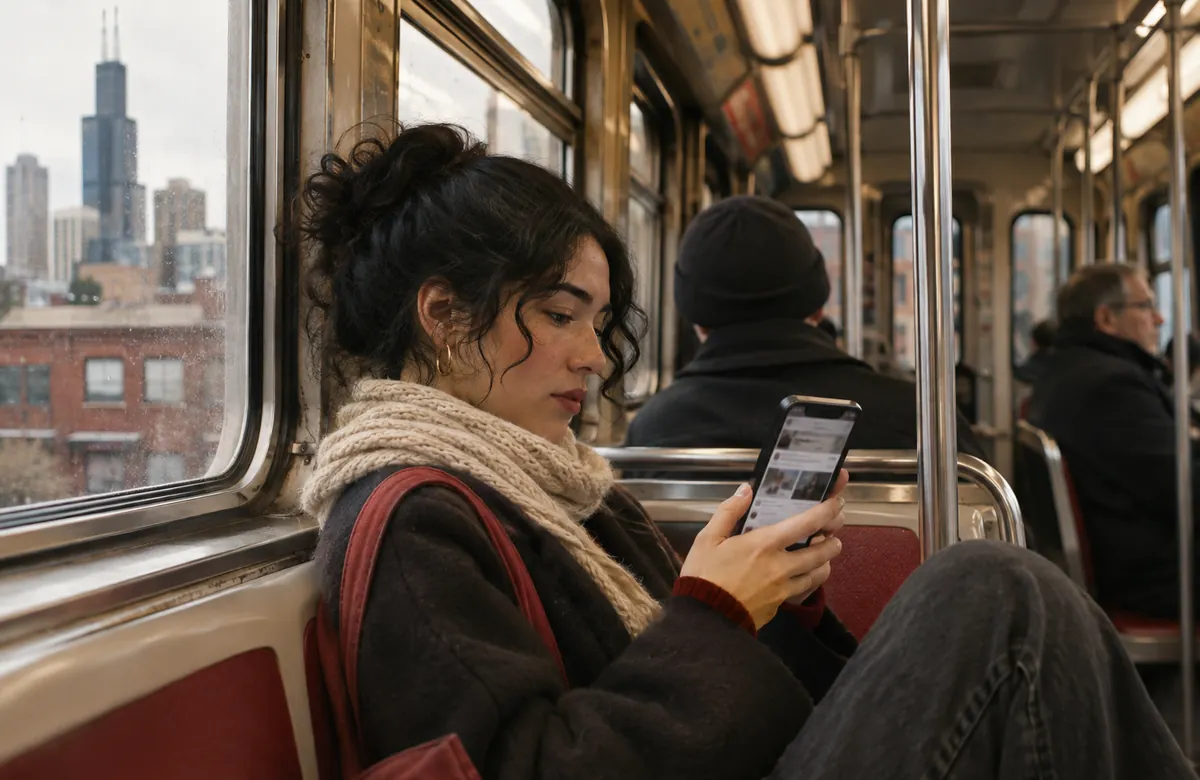
A photograph of several emergency vehicles in a Chicago intersection appears in a person's social feed. The accompanying caption says something has happened near the person's usual route home. A friend has shared it with an exclamation, and several comments propose explanations. The post itself does not identify the date of the photograph. For someone deciding whether to leave work early, that omission may matter more than the apparent scale of the incident.
The feed has become a routine place to encounter news, but the environment differs sharply from the home page of a news publication. A local article may appear between a colleague's holiday photographs and a video from another country. The original source is not always obvious, and older material can return to circulation when readers share it again. A story about a specific place and moment must retain enough information to be understood outside the edition where it first appeared.
The 2025 social media and news survey by Pew Research Center found that 38 percent of American adults regularly received news on Facebook, and 35 percent did so on YouTube. The survey measured people's reported habits, not whether each encountered item was accurate. It illustrates why a publisher should regard these environments as places where audiences actually experience news, rather than as display space for directing everyone back to an original page.
A headline written for departure
An editor composing a title for the publication home page can assume a small amount of surrounding information. An article displayed beneath the Chicago heading needs no repetition of the city's name when adjacent items and the masthead establish the beat. A version of the title shown in isolation to a reader in Milwaukee has lost that context. The place or jurisdiction may need to appear inside the social headline itself.
The problem becomes especially visible in headlines about government and regulation. A story may explain that a committee has advanced a proposal. A caption saying that the city has approved the measure could turn a preliminary action into a final decision. A reader who never opens the article would learn the wrong stage of the process. Social writing is responsible for the accuracy of that initial impression, not only for the accuracy of the underlying text.
The introduction to a shared story should make the event sufficiently concrete. Identify the body making a decision, the location and what has happened. If details remain unknown, explain which details are missing. An early account of a power interruption can report a confirmed area of disruption without guessing about its cause or promising that service will resume at a particular time. The next update can add a verified explanation.
Images carry a parallel claim
Local photography has meaning that survives even when the caption is removed. An image of a police vehicle might be used in multiple articles, but in a feed it can suggest that the photographer witnessed the particular incident under discussion. The newsroom should avoid that impression if the image comes from its general archive. A neutral image of an intersection may be suitable when the story concerns traffic regulation, but only if readers understand its relationship to the event.
The distinction is not solved by placing a tiny label on a photograph that becomes a thumbnail. A caption identifying a file image helps, as does choosing a picture that does not invite a false conclusion in the first place. For an article about a proposed building, an illustration should be marked as a proposal or an artist's impression if it does not depict a completed structure. In a crowded social environment the source and status of a photograph are part of the story's essential information.
Editors must look at the crop as well as the original. A wide photograph of a meeting might show a speaker, audience members and officials. An automatically generated square crop could isolate the expression of a single attendee and give that person disproportionate prominence. Accepting the crop without inspection leaves an editorial decision to a display mechanism that cannot understand the story.
The comment is not the interview
Local stories often draw responses from people with direct experience, and feeds offer reporters a convenient way to locate perspectives. When a story describes a late-night bus route, a passenger may mention a particular missed connection. The reporter can use the response as a reason to ask a question. It is not automatically evidence that the service fails every night, nor proof that other passengers experience the same problem.
The visible audience is also selected by its participation. People who object to a development proposal may be more inclined to comment than people who have not heard of it. Timing affects which responses appear first, and the ranking system may make contentious exchanges prominent. A paragraph reporting that residents are furious because several sharply critical comments appeared in a feed substitutes a platform's selected activity for neighborhood research.
A reporter who uses a post as the beginning of an inquiry should contact the person, establish the basis of the claim and check it against whatever independent evidence is available. A screenshot captures a public statement, but it does not establish that the account belongs to the person it purports to represent. Sometimes the better use of comments is to collect questions for the responsible organization. A follow-up can address those questions in the publication rather than arguing separately in dozens of threads.
What happens after a correction
An article can be corrected at its permanent address. A screenshot of its first version may persist. The caption supplied in a social post may remain unchanged even after the original story has been amended. The editorial remedy therefore needs to cover every prominent version of a consequential mistake, especially when the error changes the meaning of the report.
Imagine that an arts publication mistakenly announces that a free exhibition opens on Saturday. The opening actually takes place Sunday. Editing the article is necessary because people will continue to discover it, but an editor should also correct the social announcement, and consider whether a new post is needed to reach people who saw only the earlier information. The correction belongs near the mistaken statement. Giving it a less visible location because the original post performed particularly well is unfair to readers relying on the details.
Screenshots create a different problem because their copies are beyond the publication's control. The newsroom can leave a dated note on the authoritative article describing the correction. When someone later challenges a circulating image, that explanation gives them a stable reference. In contrast, silently changing the article leaves an attentive reader wondering which version the publisher stands behind.
Keep the place and time intact
Local news often concerns practical decisions made during a short interval. A description of an exhibition running through the weekend becomes misleading when the item reappears three months later without its original date. A report about a closed route may become obsolete shortly after a repair. Phrases such as today and this weekend are convenient within an edition, but they need a date somewhere that remains visible when the report travels.
Permanent pages and searchable archives give shared articles a useful life beyond the feed. A later account can explain what happened after the proposed rule reached a vote. A searcher who finds an older investigation can read an update linking it to a subsequent decision. Social distribution may send the reader to a single excerpt, but the website can supply the chronology that the fragment cannot preserve.
The editorial ambition is modest. A person should be able to distinguish an event that occurred yesterday from one recorded five years ago, and an official decision from a prediction. The newsroom cannot control the full path of its work through social networks. It can prepare each item for that uncertain journey by keeping its source, date, place and status legible. The readers encountering it at a distance from its original context deserve the same care as those who arrive at the home page.