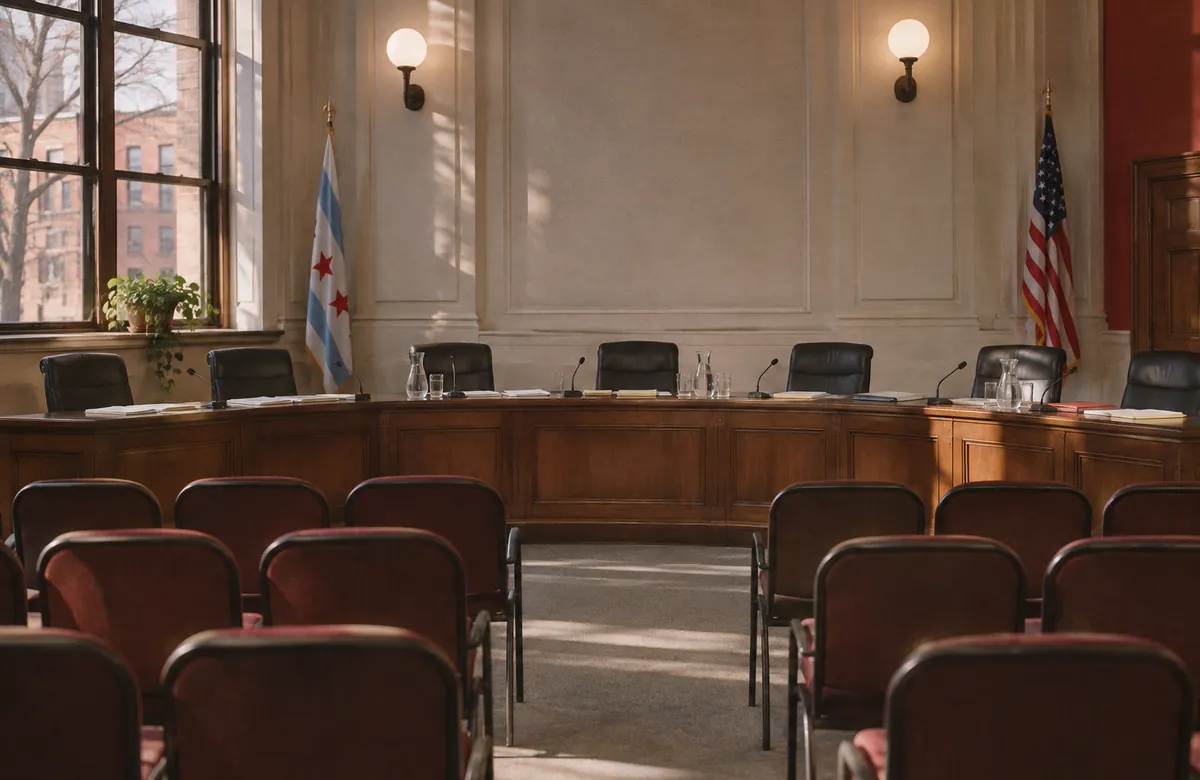
There is a familiar temptation when covering city government. A reporter sits through a long meeting, collects some colorful remarks, notes the final vote and publishes an account before dinner. The report is accurate. It may also leave out everything a resident needs to know.
Consider a committee recommending funds to restore a public playground. The vote is unanimous, and several people speak about the value of recreation. A conventional meeting story repeats the sum under discussion and the most enthusiastic quotation. But the playground might be waiting for another approval, the money might cover only part of the cost and the builder might not have been selected. The vote that took fifteen minutes may account for just one step in a two-year process.
Accountability reporting is concerned with the distance between the statement and the result. It begins with the ordinary business of government. The habit is especially useful in Chicago, where residents interact not only with City Hall but also with separate public institutions and smaller bodies that oversee particular services.
Start with the agenda
An agenda tells a reporter where to spend time before a meeting. Read it as a list of possible actions rather than a collection of subjects. Do the members intend to hear a presentation, authorize a contract or consider an ordinance? Those actions have different consequences.
Committee referral is not a final approval. A recommendation may be amended, referred elsewhere or left without further action. If a reporter is unfamiliar with a particular body, previous minutes can show how that body normally proceeds. A meeting clerk can clarify its procedure without taking a position on the substance.

An apparently technical amendment deserves particular attention. A small change in the effective date of a measure may alter which businesses are subject to it. A change to the description of a contract can expand the work for which public funds may be spent. Some of the most consequential reporting occurs while the public argument is directed elsewhere.
Make a working copy of the agenda and identify two or three items with identifiable effects. For each, try writing a sentence that begins with the people affected: residents of specific blocks, families using a service or employees assigned to a facility. If the agenda does not permit such a description, find the supporting documents before making assumptions.
Listen for claims that can be tested
A council member may call a program successful. A department may announce that a wait time has fallen. A contractor may assure the committee that a project will finish by June. None of these statements should move from the speaker's mouth into the article as established fact.
The measurable question about wait time is straightforward in principle. Which wait time does the speaker mean? Did the change involve all applicants or only cases that reached a particular stage? What period is being compared? A reduction from six months to four months may sound dramatic, but a program that previously served twice as many people could still be reaching fewer households.
The reporter will need records, definitions and a point of comparison. Sometimes a department's regular performance report contains all three. Other times the source is an internal spreadsheet that will take a public records request to obtain. Find out who collects the information while the people responsible are still accessible.
Promises deserve a similar treatment. A date is more useful than a vague description of a project as being on track. A responsible official is more useful than a reference to the city collectively. Take note of the date, the person or office accountable for the work and any conditions attached to the promise.
Find residents beyond the microphone
Public comment is valuable, but the people who can spend an afternoon at a municipal hearing are not necessarily representative of those a decision affects. A caregiver working a shift may be unable to attend. A resident who has never heard of a committee's meeting might have more direct knowledge of its subject than a speaker who regularly addresses the body.
Imagine a debate about extending a bus lane. Some attendees may oppose the loss of parking space; others may describe daily delays on the route. Both perspectives are legitimate sources of reporting. But the timing of the buses, the locations of stops and the number of passengers at different hours cannot be inferred from the relative volume of applause.
A reporter might spend time near the route on an ordinary morning and an ordinary evening. They can ask passengers where delays occur, compare experiences on different segments and speak with nearby businesses about deliveries. The purpose is not to assemble an informal vote. It is to discover facts and questions that a meeting has failed to surface.
A few carefully reported experiences can give the story concrete meaning without requiring readers to accept those experiences as a statistical sample. Explain the limits of the observation. Avoid deciding that several interviews reveal what an entire neighborhood thinks.
Treat the vote as the beginning
A recorded decision tells the public what its representatives agreed to at a particular moment. It does not establish that money changed hands, a program opened its doors or a timetable was met.
After a meeting, look for the next scheduled decision. Which office administers the project? Has a contract been executed? Does it depend on a separate body? Is the money already available, or does the approval assume future funding?
An editor can keep a list of such commitments in a shared calendar. It need not be a complicated application. Include the relevant decision, its date, the source of the promise, the expected action and the next check-in. Attach links or document copies internally so another reporter can take over the work.
A follow-up may take the form of a short news brief, not another lengthy investigation. Residents were told that a recreation center would reopen in September. By October it remains closed. The operator says repairs uncovered a further problem and provides a revised schedule. Those facts deserve publication on their own even if they produce little political drama.
Avoid the rhythm of official announcements
A government body announces something when it wants attention. Its work frequently continues after that point. If a publication allows press releases to determine the entire schedule of its coverage, its picture of public life will disproportionately reflect moments selected by officials.
Use a different rhythm for stories that involve expenditure, service delivery or safety. Assess the initial proposal, check important approvals, look at implementation and return to the issue at a meaningful interval. The stage of the process should shape the story. During a proposal, the questions concern alternatives and authority; during implementation, they concern deadlines, costs and service.
That rhythm matters when an initiative seems to have disappeared. The lack of a new announcement does not establish that a plan was abandoned. Contact the department and identify the last verifiable action. Find out whether the work was postponed, folded into another project or completed quietly.
An independent publication has limited time. Keeping every issue on a permanent list would exhaust its reporting resources. Reserve sustained follow-up for decisions with substantial consequences, especially when residents do not have an easy way to learn what happened.
Good government reporting is not synonymous with adversarial reporting at every turn. Officials sometimes explain delays clearly. Projects may finish under their approved budgets. A measured account of a department's work can expose the same level of detail as an investigation of failure.
The standard remains consistent. Who acted? Under what authority? What did they agree to do? Did the action occur? A story that supplies those answers helps the city understand itself, even when its opening sentence describes an unremarkable meeting.