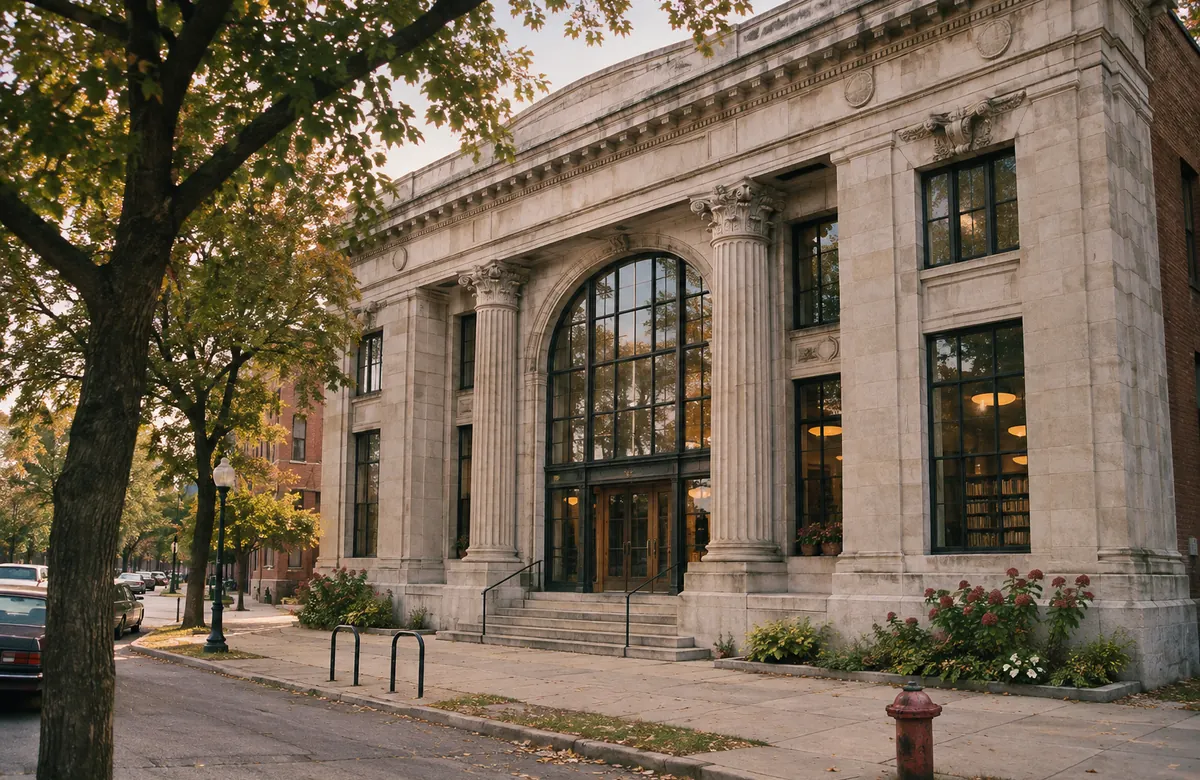
A bank building communicates an expectation about value before a visitor walks inside. Heavy masonry suggests an institution intended to outlast individual customers. In Chicago's old commercial districts, banks of the early twentieth century often look more like small civic monuments than businesses. Their halls were built to give deposits an air of permanence. When their original use disappears, the architecture remains, sometimes for decades without any obvious replacement.
The Stony Island Arts Bank offers an unusual example of what can follow that first life. The large former bank on South Stony Island Avenue in Chicago became a space for art, archives and cultural activity in 2015. The undertaking, associated with artist Theaster Gates and his Rebuild Foundation, did not simply create exhibition space in a vacant structure. It made the act of storing cultural material an important part of the building's purpose.
A visitor can understand the attraction of such a project even without a prior interest in contemporary art. The objects that document daily life are often vulnerable. A family's record collection, the printed material accumulated by a community organization or the photographic archive left behind by a small publisher may contain an invaluable account of a place. Yet no individual object in that collection is necessarily worth enough on the market to guarantee its survival.
The difference between a collection and a pile
It is tempting to imagine preservation as a matter of purchasing rare objects and setting them aside. In practice, a large collection has to be received, organized, cared for and made intelligible. Someone must recognize that seemingly ordinary items belong together. A box of books can tell a different story from a single prized volume if the relationship between the contents is preserved. Photographs need descriptions; records need sleeves; papers need a dry and stable environment.
The Arts Bank's associations with recorded music and publishing make those distinctions particularly apparent. The collection of the late Chicago DJ Frankie Knuckles, widely associated with the development of house music, illustrates how thousands of records can carry information about taste, professional practice and musical connections. The value of the records as a group is not reducible to the price a collector might pay for any one of them. Together they suggest a body of work and a history of listening.
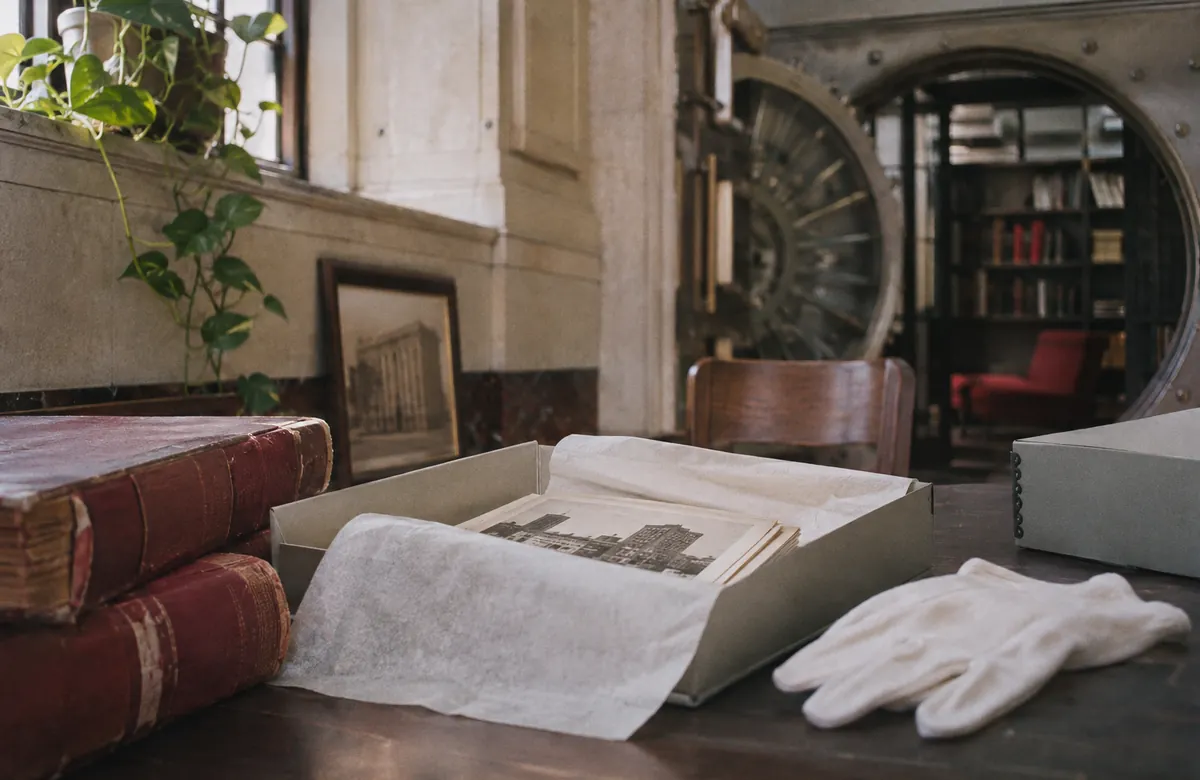
An archived publication can be just as revealing. The advertisements in a magazine might tell a future researcher about the kinds of businesses hoping to reach its audience. A letter to the editor can establish that people disagreed publicly about a subject. Typography and photographs provide evidence of how a community represented itself. Placing copies of such material in an archive creates possibilities that disappear if one salvages only the most famous cover or article.
This work inevitably involves selection. No cultural institution can accept everything. Storage space is expensive, and preservation requires time. A collection policy can help explain why certain materials received attention while others did not. When institutions have adequate resources, they can make more thoughtful decisions than a hurried clearance crew emptying the contents of a building.
Keeping the building in the conversation
The former bank gives public memory a physical address. This matters in an era when archives can be imagined almost entirely as searchable data. A researcher working from scanned material does not generally have reason to think about the original building where the papers were held. Someone walking into a historic property encounters both the collections and the architectural history of the institution now responsible for them.
For neighborhood residents the building may also carry personal associations. A bank that closed long ago may have stood beside shops they visited regularly. A relative might have recalled depositing money or applying for a loan there. The boarded windows and empty facade would have been part of another generation's experience of the same street. The reopening gives residents a reason to connect those separate memories without pretending that the institution's past is entirely recoverable.
Adaptive reuse is often discussed in terms of square footage, economic recovery and the visual appeal of historic construction. The Arts Bank encourages another comparison: what social activity can fill a structure built for an earlier pattern of neighborhood life? Conserving a shell matters, but occupancy gives that shell a continuing relationship to the street. The building's new purpose depends on attracting people who want to spend time there.
The substantial interior of an old bank can be particularly well suited to events and exhibitions, although it also presents preservation problems. Walls that once provided privacy or security can divide spaces in inconvenient ways. Temperature and humidity must be controlled if sensitive objects are present. A careful renovation preserves the useful qualities of the existing building without requiring every new activity to conform to an obsolete floor plan.
Who gets to interpret the materials?
An archive can remain technically intact and still contribute little to public understanding. Shelves full of materials are not much help if nobody knows what they contain. Exhibition, interpretation and research access determine whether the surviving collection can make a difference in the surrounding community.
One productive approach makes room for several kinds of visitors. A music historian might be concerned with the chronology of recordings. A producer could arrive with an interest in techniques that have changed between formats. A local resident may associate a particular song with a dance floor or a radio station. The institution need not decide which interpretation is the only valid one. Instead, it can make the physical evidence available and provide enough context for each visitor to understand what they have found.
That creates the possibility of a continuing exchange between a collection and the place where it is held. Cultural historians who come from elsewhere can learn from people whose everyday lives shaped the artifacts. Residents who regard an object as familiar may discover why it interests researchers. An archive may reveal the significance of something that was common enough at the time to escape special attention.
Contact with the public also exposes errors and omissions. A person who recognizes a street in a photograph may supply a detail absent from a formal catalog. Researchers can distinguish an original item from a later reproduction. Receiving such knowledge requires a sensible method of recording it so a casual suggestion is not mistakenly treated as a proven identification. The process is slow, but its results can be considerably more accurate than a single curator's first description.
A wider idea of investment
A large arts institution usually costs considerably more to maintain than an ordinary storefront. In a neighborhood with competing needs, it is reasonable to ask what such an expenditure accomplishes. Preserving cultural collections may seem a distant concern when wages, housing and access to routine services are immediate difficulties. The activities are not identical, and no archive can solve every surrounding problem.
The argument for a place like the Arts Bank rests in part on the distinctive contribution it can make. A robust cultural institution provides reasons to visit an area that do not depend entirely on shopping. It can employ people with expertise in building maintenance, arts production, archives and community programs. Its public activities may bring a person into an unfamiliar collection or introduce someone to a historical record otherwise unavailable to them.
Some of those effects are easy to observe and others are difficult to measure. A well-attended event has a countable audience. A young producer discovering an unfamiliar recording may benefit in a manner that becomes apparent only much later. A family whose cherished materials are accepted into an archive has a measure of reassurance about their survival. No single visitor figure can explain the value of these events.
The reopening of the old Stony Island bank in 2015 suggests that urban conservation can be understood as something more substantial than a way of making an attractive building useful again. Its collections invite an ongoing reconsideration of which things are worth keeping. Sometimes the next important cultural discovery begins with the recognition that an ordinary object should never have been thrown away.