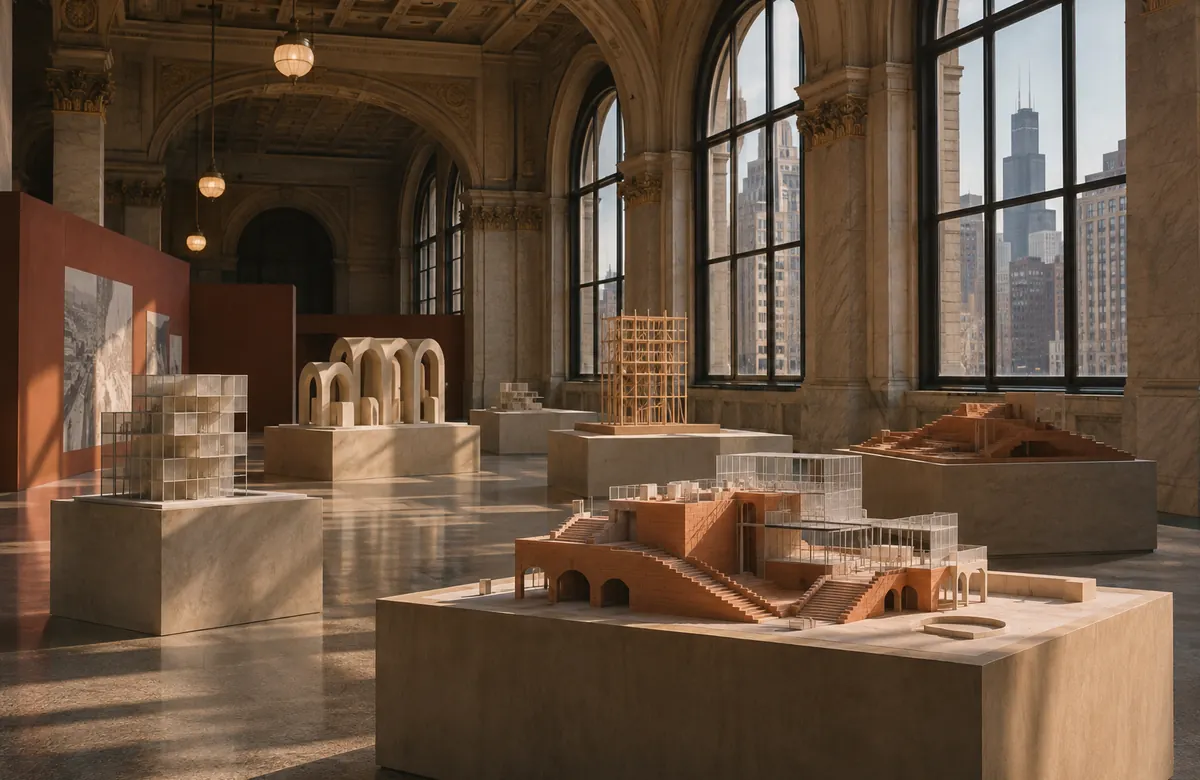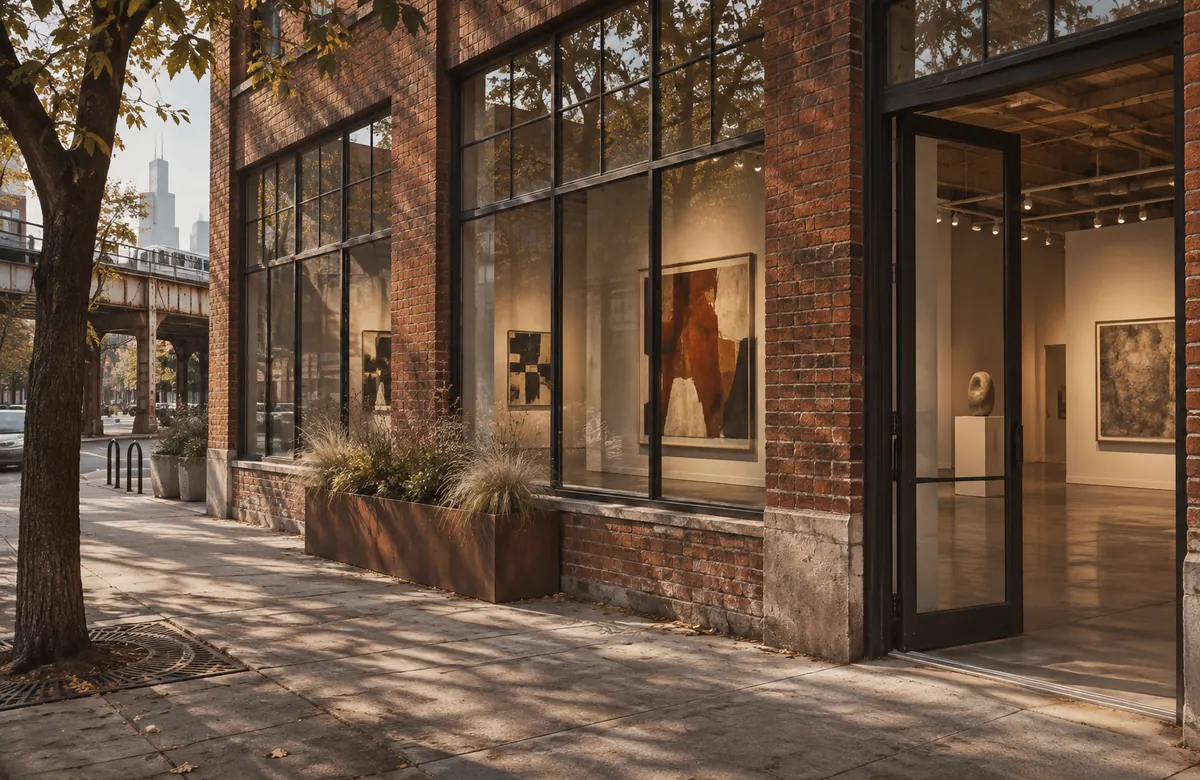
A visitor to a museum can often tell how large a collection is before entering the building. Gallery visits in Chicago rarely provide that kind of advance notice. A short staircase might lead to a room containing a series of new paintings by someone whose work you have never encountered before. A wide opening in the wall of what used to be an industrial building may accommodate an installation involving a surprising quantity of material. The relationship between the room and the works on display is rarely neutral, and its evident particularity can make looking at them a more memorable experience.
Some of the city's galleries occupy buildings erected for purposes unrelated to art. Their concentration in certain neighborhoods has developed through the interaction of practical factors, including where people can afford to maintain a studio, how large an exhibition room needs to be, and how it can be reached by those interested in art. A trip through several such neighborhoods can provide one of the better informal courses in Chicago's cultural geography.
Why galleries move
River North acquired a concentration of art galleries during the latter decades of the twentieth century. Existing commercial buildings with substantial interiors could be adapted to exhibitions, and a developing interest in the area among collectors made the location particularly appealing to other dealers. In some respects that is a familiar economic arrangement. Having a choice of galleries within walking distance gives visitors a reason to undertake the trip in the first place, and the presence of those visitors creates an opportunity for another business to become established nearby.
Yet galleries have very different requirements. A dealer showing paintings on a conventional wall might favor a room that provides excellent artificial or daylight illumination and enough space for visitors to stand back. An organization exhibiting large objects has to consider the size of the delivery entrance, the height and strength of the ceiling, and whether a heavy work can be placed on the chosen surface. An artist using sound may benefit greatly from finding an inexpensive room in which neighbors cannot hear every element of the work.
Spaces in parts of the West Loop and other former industrial areas have provided some of the answers. They can also expose the people working in art to urban redevelopment. A neighborhood that offers manageable rent when the first artist moves there may become considerably more expensive by the time the artist has developed a regular following. Commercial demand for larger buildings can bring opportunities to a dealer with substantial means and eliminate others' access to the whole area. No map of a city's gallery districts remains accurate indefinitely.
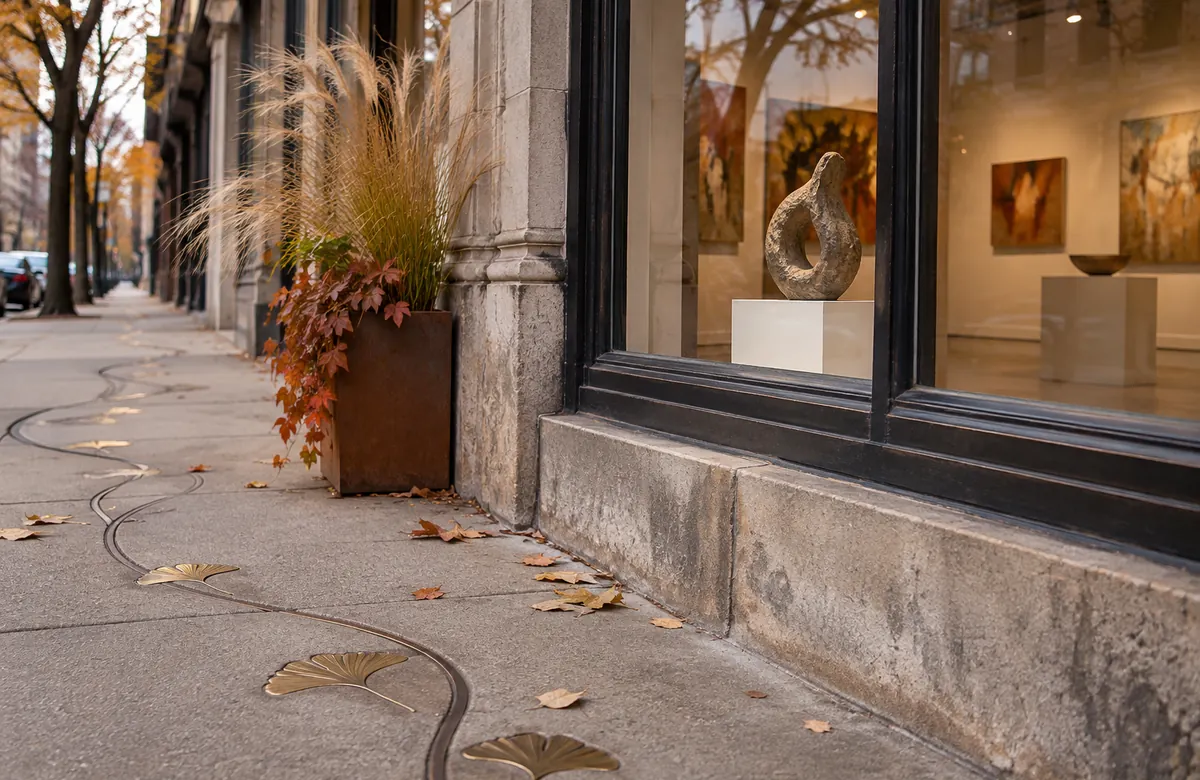
A building's previous use affects the kind of work it can accommodate, and sometimes its atmosphere. Rough walls and visibly worn floors are not always convenient surfaces, but they can be unexpectedly informative when presented beside material with a different history. A room designed to present buyers with finished objects creates an impression quite unlike that of an exhibition sharing a building with working studios. A walk from one to another yields a variety of experiences without any change in the category of art being shown.
Studio buildings and things that are not yet finished
In Pilsen, the Chicago Arts District includes galleries and creative spaces around 18th and Halsted streets. Some of the spaces organized by artists use a modest scale to their advantage. The people who show their work may maintain a studio nearby or participate in an exhibition themselves. A visitor with a sincere question about an object's surface could be asking it of the person responsible for that surface.
This is a different circumstance from an exhibition in which a visitor only encounters a finished work and some carefully prepared information. Seeing a sketch or an older piece in the same room as a new work can make the steps in the artist's thinking particularly clear. Materials in the studio may be evidence of something that will not become part of a successful work for several years. That uncertainty is integral to making art, although it is generally hard to observe in museums that must choose whether a given object is ready for permanent display.
There are comparable possibilities around Wicker Park and Bucktown, where buildings devoted to creative work have gathered artists whose occupations would not necessarily overlap otherwise. A visitor interested in photography might find that the most rewarding event of an open-studios evening is a discussion with someone working on sculpture. They face different specific problems and may have made similar discoveries about how scale changes the meaning of an object.
Be attentive to the conditions of the invitation. Work displayed during a public opening can be enjoyed freely, but the adjoining rooms may serve as private working spaces. An artist is not necessarily offering a demonstration of their processes or making an object available to handle. A good visit involves taking an interest in what has actually been made available rather than treating the whole environment as a material resource for one's own curiosity.
Art as a reason to travel between neighborhoods
Bronzeville offers another instructive aspect of the relationship between galleries and their surroundings. Its long history as a center of Black culture forms part of the context for institutions and galleries showing work by artists of the African diaspora. The Bronzeville Art District has included spaces such as Gallery Guichard and the Bronzeville Artist Lofts. Programming related to the district has enabled visitors to travel between different exhibitions in a relatively short space of time.
There is a benefit in extending such a visit beyond the rooms that show art. Consider how the buildings on the route and the businesses nearby have changed over the course of their lives. Think about the history of a district where commercial, political and artistic activity helped shape the conditions under which an earlier generation could make things. Contemporary works need not address those changes directly. They exist in a landscape that helps a visitor understand the city in which people undertook the work.
University galleries and nonprofit art centers offer another route through Chicago's exhibitions. An organization associated with an educational program may have less need to develop a commercial market for the objects on display. It might provide a setting for experimental forms or make public the results of a sustained investigation by a group of artists. A visitor may find equally absorbing work in those circumstances and in a gallery representing artists who sell their work regularly.
Looking before asking about a price
The fact that a commercial gallery sells things can discourage visitors who have never been in the market for an original piece of art. In most public exhibition settings, a willingness to look is a perfectly adequate reason to enter. Walk through the space, consider the works, and acknowledge the person maintaining the room. If you are interested in the work available for purchase, you can ask for information. There is no necessity to present yourself as a collector otherwise.
Compare exhibitions in groups of two or three. An artist showing color in a large room may have organized the pictures around relationships evident only from a certain distance. A series of small photographs in the next room may enable you to concentrate instead on a tightly framed detail. By going between these settings, you can avoid developing a single habitual way of looking at different kinds of work.
The ordinary urban fabric around Chicago's galleries has much to do with their appeal. It is possible to feel connected to the work being produced in the city without knowing a great deal about the individual artists beforehand. Small narrative discoveries accumulate over successive visits: a name on a gallery wall comes to seem familiar, a partly finished piece encountered earlier reappears in a different form, or a particular street acquires a reputation in your own memory for an extraordinary installation. That familiarity and critical attention keep the city's art districts interesting over time.