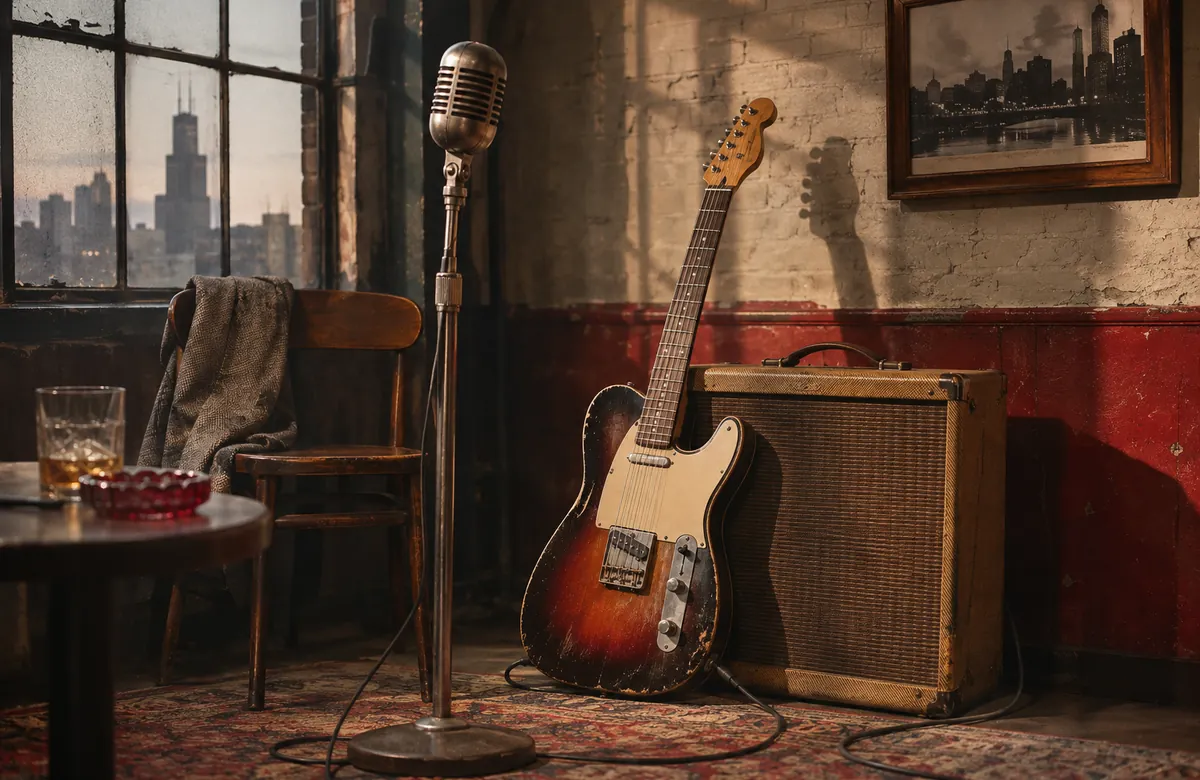
At the center of many early Chicago blues records is a deceptively simple arrangement: a voice, a harmonica, perhaps two guitars, a bass and drums. The record can sound enormous nevertheless. A distorted note from the harmonica seems to occupy a place not far from the singer. The guitarist answers the end of a phrase with a compact sound of his own. The individual components are small; the effect they make together extends well beyond their dimensions.
The amplification of the blues in Chicago is often explained as a matter of using electric instruments to cope with noisy bars. That is part of the practical story. The sound also reflected choices about rhythm, volume, arrangement and the character of a voice. As the music moved through different kinds of performance settings, musicians discovered that the new equipment allowed them to emphasize qualities that were already present in southern blues traditions.
The story behind the amplifier
Chicago was one of several northern cities transformed by the migration of Black Americans from the South during the twentieth century. People who took that journey came to the city with memories of music performed at homes, community gatherings and other informal settings. They also brought experience of the difficulties involved in earning a living under segregation. That experience informed the songs people wrote and the way their audiences understood them.
There was no single rural tradition that became Chicago blues. Performers knew a variety of regional approaches. Some had accompanied themselves on guitar; others had already played in groups. The move to a large city gave them opportunities to hear and work with musicians whom they might not otherwise have encountered. A song suited to a single acoustic guitar could acquire the sound of a fast-moving ensemble without losing its essential form.
Listen to a rhythm guitar part and observe the way it leaves room for words. A singer can deliver a long sentence across several measures, and the guitarist can reply as if the sentence were the opening of a conversation. At other times the drummer sets up a small moment of tension before the band returns to a familiar figure. The pleasure comes partly from recognizing the pattern and partly from discovering what the musicians do within it. Electricity makes a reply more emphatic without determining its content.
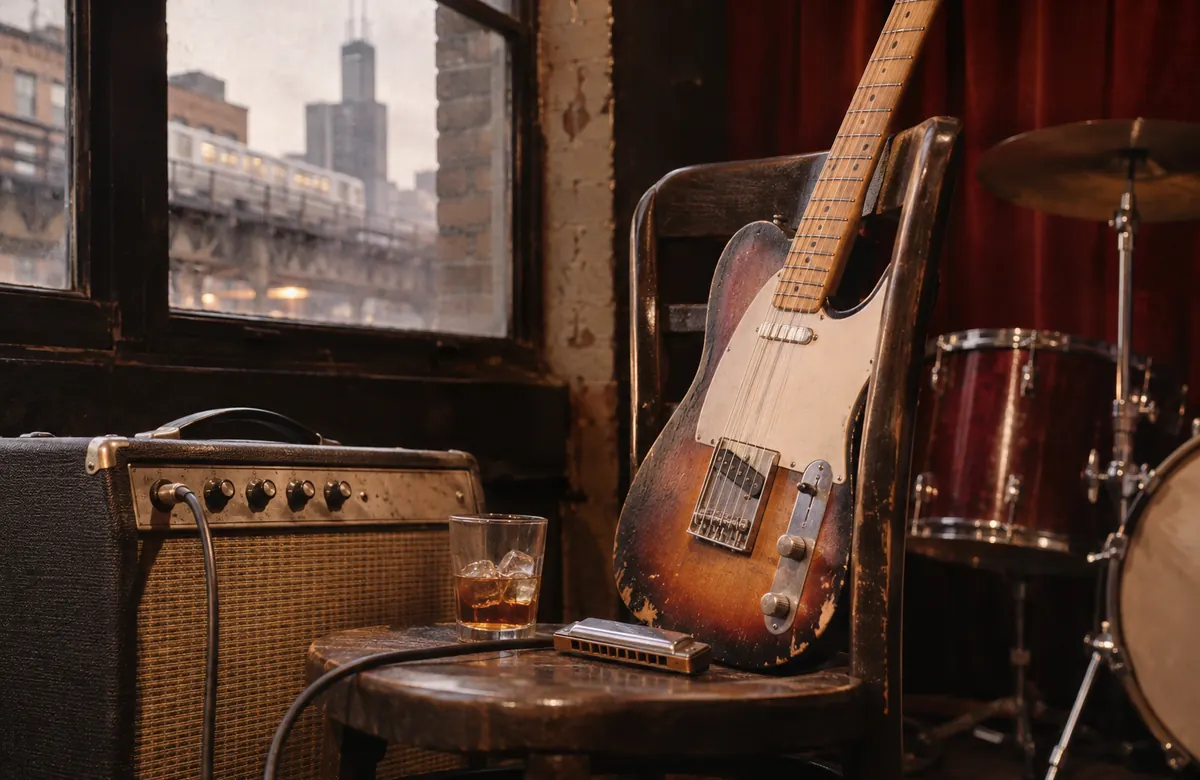
Many of the greatest performers in this idiom were skilled at managing the limitations of early equipment. A microphone could amplify the harmonica but also produce distortion when a player cupped it close to the instrument. The sound became expressive in its own right, less like a faint acoustic instrument rendered louder and more like a newly available kind of voice. An inexpensive piece of equipment, used intelligently, could create an unmistakable sonority.
The building on South Michigan Avenue
Chicago's recording history is unusually tangible. In 1957 the Chess brothers began using their facility at 2120 South Michigan Avenue, a building that remained associated with the company until 1967. Records by artists including Muddy Waters, Howlin' Wolf and Chuck Berry were made there. The site became a Chicago Landmark in 1990. It makes an instructive contrast with the ornate cultural buildings often pictured on postcards of the city.
A commercial studio brought its own demands. A performance had to fit a record. A compelling song needed to communicate before the end of a short track, ideally in a way recognizable from a few bars. Players and producers developed arrangements that distinguished the sound of a given song and gave its singer a clear part. Musicians worked within schedules and economic constraints; the finished record could hardly communicate every decision behind it.
Willie Dixon's work illustrates how easily the division between those jobs can blur. A bass player, songwriter and producer, Dixon had the ability to hear the arrangement of a song and write material adapted to particular performers. A memorable Chicago blues song might be associated with the individual who recorded it while owing some of its structure to the contributions of a collaborator. That is true of recording genres generally, but the close interdependence of the components is exceptionally audible on blues records.
The later life of the original building is also a reminder that music history is about labor and property as well as famous recordings. A historic site can help people notice the physical circumstances of making art. The unremarkable size of the building on South Michigan Avenue corresponds badly with the influence of the recordings associated with it. That disparity is worth reflecting on before assuming that creative importance is indicated by the size of an institution.
What survives in the contemporary club
Someone encountering blues chiefly through celebrated historical recordings may have an incomplete picture of the work a modern blues band does. The music's shared forms make it possible for people to play together after relatively little preparation, but good performances depend on technical judgment and attention. A shuffle can feel heavy or buoyant according to the way the rhythm section handles it. Different guitarists can approach a similar phrase and communicate noticeably different emotional states.
This quality makes Chicago blues clubs an education in the sound itself. Kingston Mines in Lincoln Park, Buddy Guy's Legends south of the Loop and Rosa's Lounge on the Northwest Side are notable examples of local places devoted to performance. Their programs have included touring and Chicago musicians, and an evening can expose a listener to artists who approach the tradition with distinctly different intentions.
It is worth arriving without an expectation that every musician will recreate a celebrated recording. A guitar player who emerged decades after Muddy Waters may have encountered blues in a very different order: through soul, rock, contemporary gospel or musicians who brought another genre into their own work. That route through the music is legitimate. The repertoire and vocabulary survive because they can be worked on and recognized by people of different generations.
A short solo is particularly revealing. Sometimes a listener will hear an apparently easy succession of notes played with such a precise sense of duration that it becomes difficult to remember the phrase without its timing. Another player may be able to introduce a sound that resembles a human sigh without relying on many notes. Technique of that kind is not reducible to speed.
Hearing the festival differently
The city's free Chicago Blues Festival makes it possible for visitors to experience some of this variety in one place. A large outdoor performance encourages a different relationship with the music. Dancers, children, people meeting friends and devoted listeners all share a public space, and the sets can become an informal introduction to an artist's work. In a club the same group might make a different set of decisions about dynamics and pacing.
Try listening to a recording by a performer after experiencing the artist in person. Often the apparently familiar pattern acquires greater interest once you have seen the gesture that makes a sound. The singer's timing becomes easier to understand. A record made before musicians were born can be almost instantly recognizable to them and still leave room for a new interpretation.
When a record begins with a guitar figure and a bass line that seem inevitable, remember that these are choices made by people. Someone thought to leave a gap in the rhythm, someone wanted to raise the volume at a particular point, and someone else was attentive enough to follow the change. The recordings made in Chicago put an unusually durable form around that mutually responsive work. The city's live performances make it possible to hear the work continuing.