A festival schedule can make a person feel as if they are studying a map of a city they have never visited. Some of the names are familiar, others carry an appealing suggestion of something unusual, and the descriptions give a tantalizingly incomplete idea of what awaits. The temptation is to reduce the possibilities to recognizable actors and directors. A more interesting approach is to choose at least one film using information that would not ordinarily lead you to buy a ticket.
Chicago has been a useful place to practice that approach for a long time. Local festivals have exposed audiences to experimental films, work from countries ordinarily excluded from mass-market exhibition and American independent movies made without the backing of a major studio. A festival occupies a distinctive position in the life of an art form that is particularly expensive to distribute: it can concentrate an audience for difficult-to-find work into a few days.
An alternative to the multiplex
Michael Kutza founded Cinema/Chicago in 1964. Its first Chicago International Film Festival followed in 1965. The festival's explicit interest in films not readily available in commercial theaters distinguished its undertaking from ordinary film exhibition. In a large American city, access to movies from around the world remained uneven. A distributor's decision that a work was commercially promising could matter as much as the quality of the film itself.
Film festivals create a temporary market with its own economics. It is possible to promote an entire program under a single recognizable name and give particular attention to a picture without making it responsible for filling a whole calendar of shows. A person who would hesitate to travel across Chicago to see an unfamiliar 90-minute drama during a commercial run might take that chance after noticing the film in a festival's selection. The institution lends some of its reputation to the work.
That model also gives the organization a complicated responsibility. It must decide which pictures merit attention from among large numbers of submissions and other possible programs. A festival schedule can be shaped by relationships with distributors, producers and filmmakers as well as by the artistic judgments of its programmers. The audience encounters the result of many decisions it does not directly observe.
Successful festivals often become known for the kinds of discoveries they make possible. The Chicago International Film Festival presented an early feature by Martin Scorsese in 1967. In retrospect, that event seems important because of the director's subsequent career, but the significance of the work on the night of its original screening could not have depended on that later knowledge. The film had to be worth seeing on its own.
Filmmaking conversations after the credits
There is a practical educational dimension to festival screenings. An ordinary viewer has few opportunities to learn why a director chose to keep the camera at a distance during a particular scene, or why a story ends before a certain event. If a director or editor appears for a discussion following a film, viewers can ask about precisely that detail. Understanding a production decision does not necessarily make the movie better, but it can reveal a form of craft that is otherwise difficult to recognize.
For filmmakers, such a conversation provides a kind of information not captured in a financial report. The reaction to an unfamiliar ending can be revealing even if the response is unfavorable. A director may discover that details regarded as incidental by the people who made the movie are the ones the audience has found memorable. It is possible to conduct this conversation more fruitfully in a room with people who have just encountered the entire work than in the scattered responses that follow a streaming release.
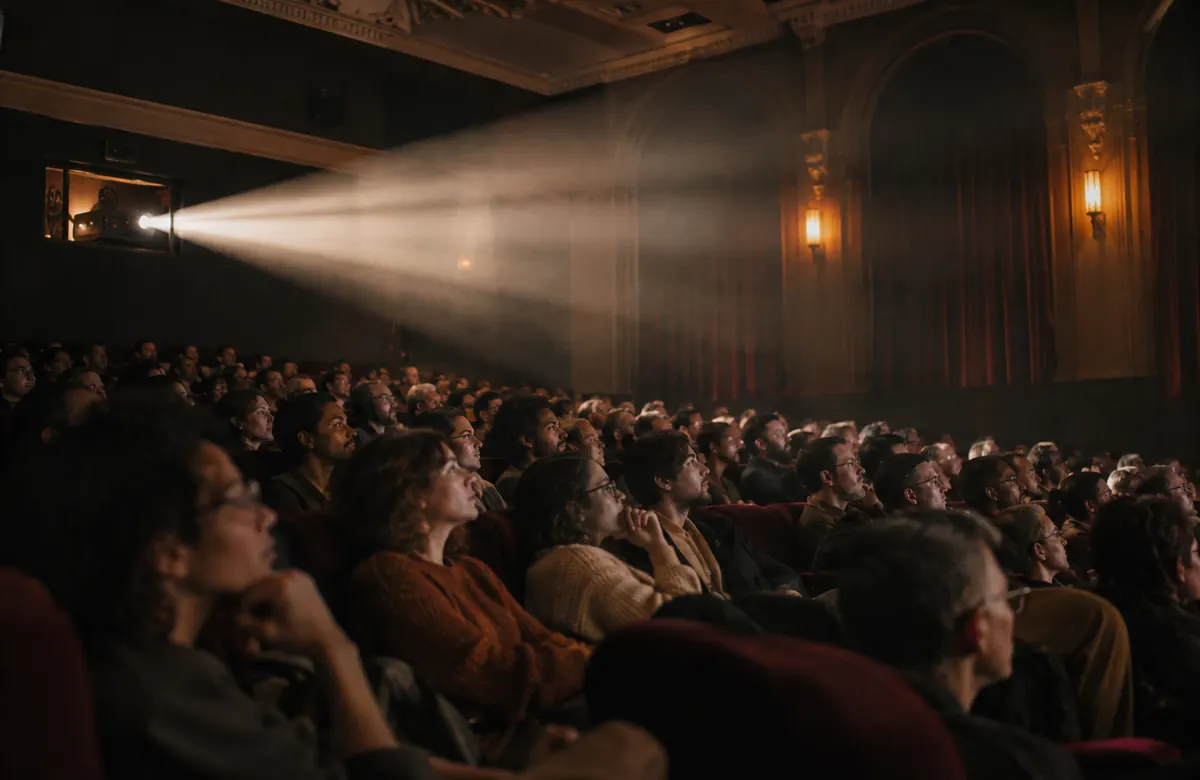
The festival atmosphere helps. People discuss pictures while waiting outside a theater, exchange impressions of a recent screening and recognize some of the same faces throughout the week. They may not feel especially devoted to any one director before the festival begins. The combination of an exciting schedule and an attentive audience makes filmmakers' professional concerns part of a public conversation about art.
The less glamorous screenings are worth including. A well-known actor's visit may generate an enormous amount of activity and leave little time for a genuinely exploratory question. A small documentary with a modest production budget sometimes prompts a discussion that lasts well beyond the scheduled credits. Use the setting as an opportunity to encounter film as a process rather than a product.
A festival that left the theater
In October 2020, the Chicago International Film Festival continued in hybrid form. It offered virtual viewing and screenings at drive-in venues. The opening program included the documentary Belushi, shown at ChiTown Movies in Pilsen, with a simultaneous opportunity to watch virtually. The subject's connection with Chicago's comedy scene made that setting especially appropriate. Most importantly, the festival managed to maintain an exhibition schedule during a period when much indoor public activity was restricted.
The move posed specific questions about the organization of a festival. Virtual screenings could reach people who could not travel easily to the chosen venues. They could reduce some of the inconveniences of fitting a visit to a theater into a workday. Yet it is considerably harder to reproduce the spontaneous interactions between spectators that contribute to the experience of an in-person festival. Someone who watches a movie at home may have little occasion to discover what everyone else watched immediately before it.
A drive-in offered a different compromise. The arrangement protected some of the physical separation of the audience while preserving the sense of people devoting the same time to the same work. It allowed a screening to become an event again. The picture's delivery and the nature of audience participation were different from those of a theater, and the limitations were perfectly visible. What a festival needed to retain during that period was the ability to introduce selected films to an audience in the face of those limitations.
The institution's sixtieth anniversary edition in 2024 offered an opportunity to reflect on that durability. The practical ways of encountering films had changed enormously over six decades. The gap between organizing an international festival in the mid-1960s and programming one after the rise of streaming was wider than any individual technological change in projection. The continuing attraction of an occasion devoted to seeing films selected for particular reasons is evidence that exhibition has an artistic value of its own.
Planning a week of discoveries
Chicago's significant film festivals encompass far more than one annual international showcase. Programs centered on particular regions, independent production or underrepresented communities can provide a more substantial introduction to the work of a set of filmmakers. Their smaller scale is often an advantage. Someone exploring a particular national cinema may have a chance to hear an artist discuss conditions of production and compare films by directors who live in the same place but have very different experiences.
Read the schedule with an eye toward these differences. Leave enough time to travel and perhaps have a brief conversation after a screening before you hurry to another one. Consider setting aside a day for shorts: curated programs of short work offer a density of ideas that is very unlike a series of features. The most memorable film of your week might be an eleven-minute picture that had never been advertised to you beforehand.
Unfamiliar movies become less intimidating after a succession of enjoyable encounters with them, and the festival organizer's effort to introduce work outside established commercial channels becomes easier to appreciate. Once the year's event is over, take the names of several artists home with you. Following their later work helps preserve the relationships between audiences and filmmakers that a festival makes possible in the first place.