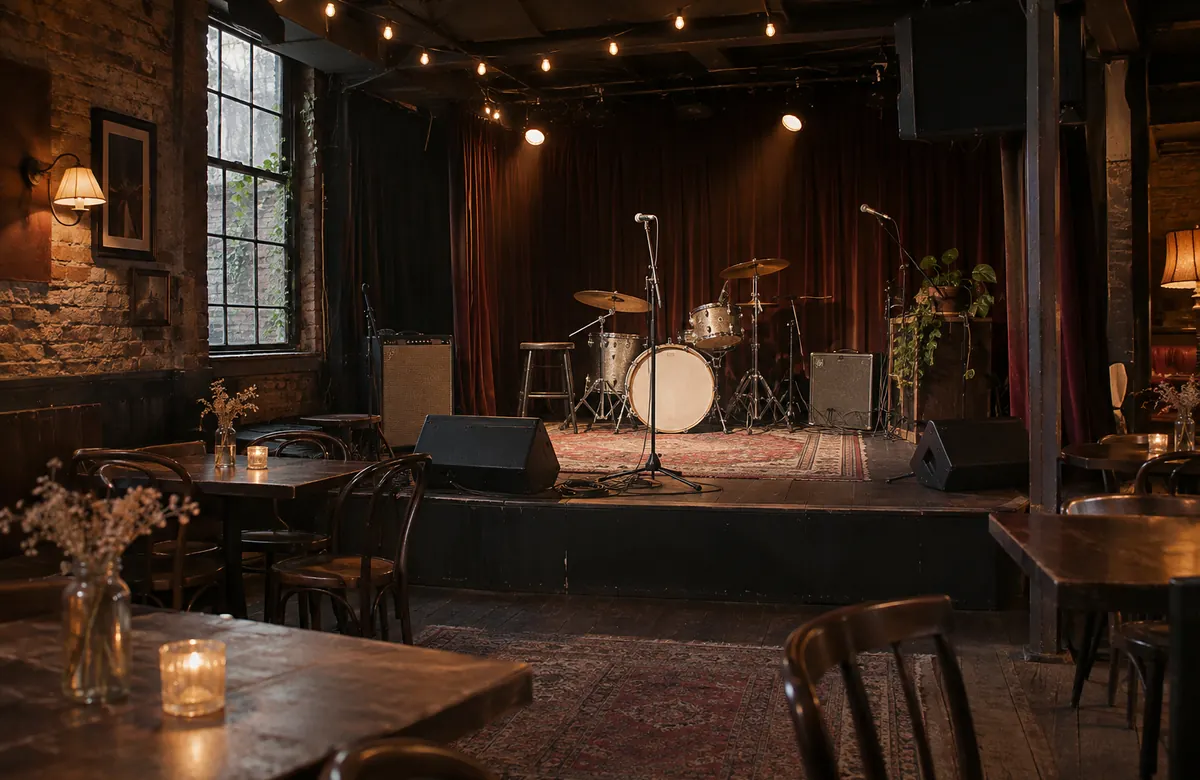
Consider the size of the stage occupied by a band near the beginning of its career. The drummer may have to arrange the kit carefully to leave enough room for the other performers. The movement of a guitarist toward the audience affects the space left for the singer. At the front of the room a person who has never heard the music can already see the labor involved in getting enough equipment into position to play it. Those limitations are not necessarily a problem for the audience. They can make the performance particularly exciting to witness.
Chicago has long supported a range of rooms in which a band can undertake such work. Some places have been associated with a particular kind of music; others have developed regular audiences interested in a remarkable variety of performances. Small venues enable people to encounter the work of musicians before the artists have gathered the resources to produce a full album, let alone bring a traveling show to an arena. For those who make the music, each successful evening can help lead to the next one.
A bar develops a musical identity
One of the city's familiar independent venues, the Empty Bottle, began in Ukrainian Village in 1992 and moved to another nearby building the following year. The larger room and its equipment enabled a more ambitious performance schedule. The venue's history illustrates a practical advantage of transforming an existing place of business into a musical gathering place: some of the ordinary relationships with the surrounding neighborhood are already present before the first musicians arrive.
The distinctive character of the venue emerged over time. Programmers developed contacts with performers, organizers and people familiar with different musical communities. Some spectators came to recognize the nature of the work presented there. An individual artist's reputation does not by itself explain why an unfamiliar band on a particular evening draws people to an independent club. Familiarity with the bookings of that club can offer an equally persuasive reason to attend.
This is also a service to the musicians. Someone booking a large national tour generally has far more information about likely audience size than a musician arranging a first series of dates outside their hometown. A programmer who already knows something about the audience's interests can find other performers with complementary work. A small local audience then has a chance to discover the visiting musicians without having to undertake the complicated task of learning what everyone touring the region is doing.
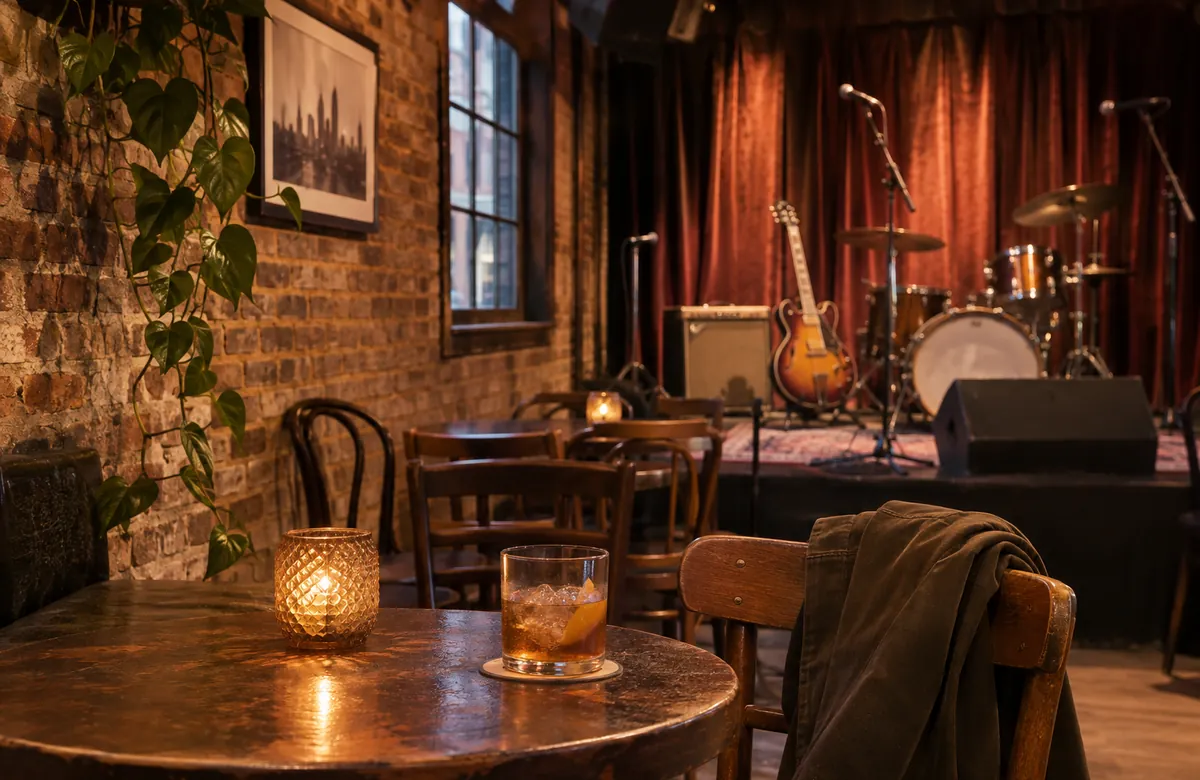
There is considerable importance to a venue's physical equipment. A new band may not yet have the resources to transport an elaborate sound system to every town in which it hopes to perform. Arriving somewhere with a functioning system and a capable person operating it reduces a number of possible difficulties. The size and shape of a room still pose problems, but it has become someone's business to learn how those problems can best be handled.
An old public hall finds a new function
Thalia Hall in Pilsen offers a notably different story of the relationship between the character of a building and the music presented in it. It was built in 1892 as a multipurpose property including a hall intended for community events and other spaces. The design of the theater took inspiration from a building in Prague, reflecting the significance of the area's Bohemian community in its early history.
Following a long period in which the performance space was closed to the public, renewed activity in the complex began in 2013. Thalia Hall's redevelopment made it possible to accommodate musical performances in a setting with an established local architectural identity. The venue's position in an existing neighborhood, rather than its being isolated in a newly constructed entertainment area, invites attention to how many different sorts of activities the surrounding streets have accommodated over time.
Consider the contrast between that space and a small rock club. The larger hall allows a different physical arrangement for the musicians. It needs to accommodate groups whose equipment and personnel may take up more room than an emerging band possesses. It also makes an engagement viable for performing artists whose Chicago audiences have outgrown the settings in which those audiences might originally have developed. The existence of several scales of independent venue in one city offers artists particularly useful flexibility.
Different rooms affect the presentation of similar music. A singer communicating directly to several dozen people can adjust a performance in response to their reactions quite quickly. An artist on a large stage may need to think about how a particularly expressive movement will be seen from farther away. The same songs can be effective in both settings while the musicians acquire strikingly different ways of presenting them.
The cost of keeping a door open
Operating a venue requires considerably more activity than the audience ordinarily has occasion to see. Schedules must be prepared, agreements with musicians made and information about events circulated. Equipment needs to remain functional over a succession of performances, each of which may place quite different demands on it. People must be paid to do all of these things before there is any certainty about how much money a particular evening will generate.
The venue's economic interests do not always coincide neatly with the kinds of music the people working there find most interesting. An established performer may draw a large audience for a show whose revenue supports less predictable bookings. A small venue can give artists more of those unpredictable opportunities if enough people become familiar with the character of its programming. Its strength as a cultural institution can derive from the same accumulated relationships that give it the resources to remain open.
In 2020, many venues encountered a particularly acute form of this economic difficulty. The immediate closure of spaces for live music eliminated many of the activities through which a venue could generate income. The ongoing costs and the uncertainty about how soon performances could resume placed stress on the organizations involved. A musician might be able to work separately from the rest of the band to make a recording; the business that ordinarily arranged the group's shows had far fewer immediate alternatives.
The relationship between venues and artists became particularly evident during that interruption. Losing a room devoted to a particular kind of performance affects the future possibilities of bands that have not yet traveled to the city as much as it affects those who previously played there regularly. A Chicago musician who could ordinarily make early decisions about the viability of a new project by presenting it to a roomful of people would have to find a different way to gather that information.
Following the bands, and following the rooms
Consider beginning your next musical evening by looking at a venue's whole calendar rather than entering the names of familiar performers into a search bar. An opening band may offer some of the most interesting work on an evening initially devoted to somebody else's songs. A show programmed on a relatively quiet weeknight may introduce a group from elsewhere whose music will subsequently make sense of several new recordings encountered at home.
The best audience an independent venue can develop is one willing to make those discoveries. Such people not only buy a ticket when a band they know is appearing. They gradually acquire an idea of the types of decisions a venue makes about its calendar. In Chicago the range of places presenting live music makes it possible for musicians and listeners to continue making unfamiliar aspects of their work available to one another, long before any of the participants need to pretend that a particular room can be filled thousands of seats at a time.