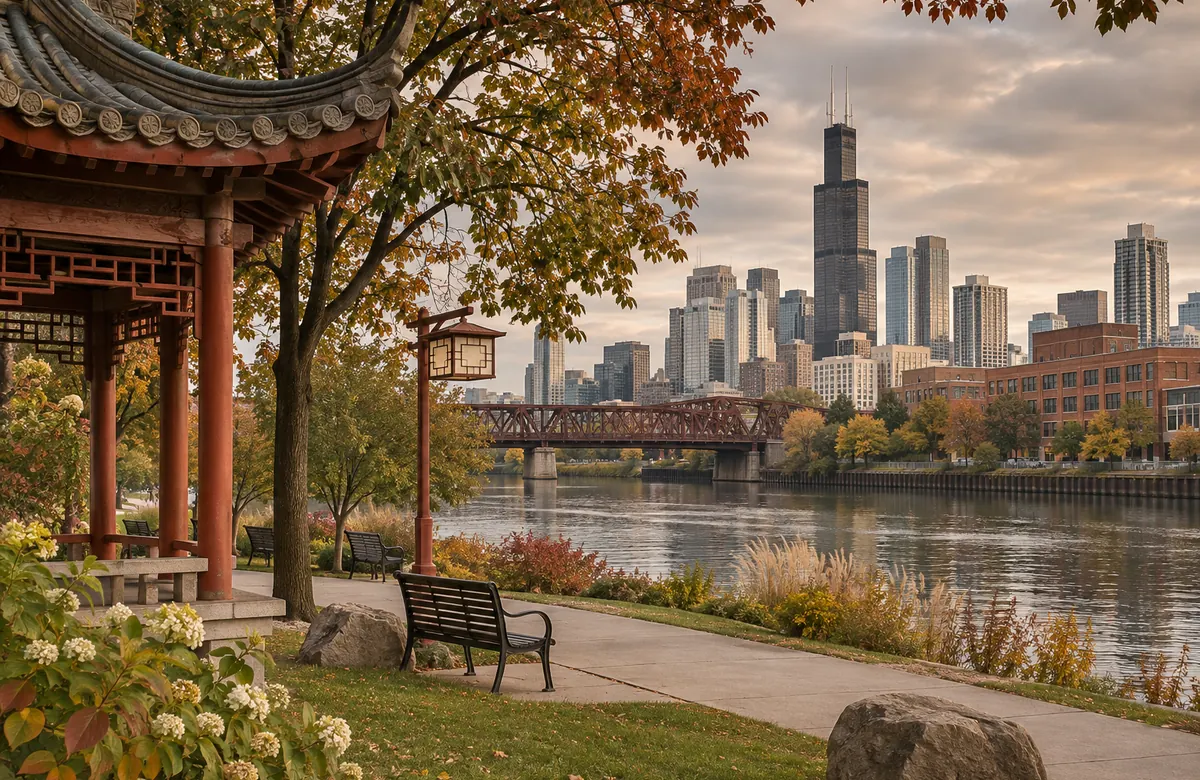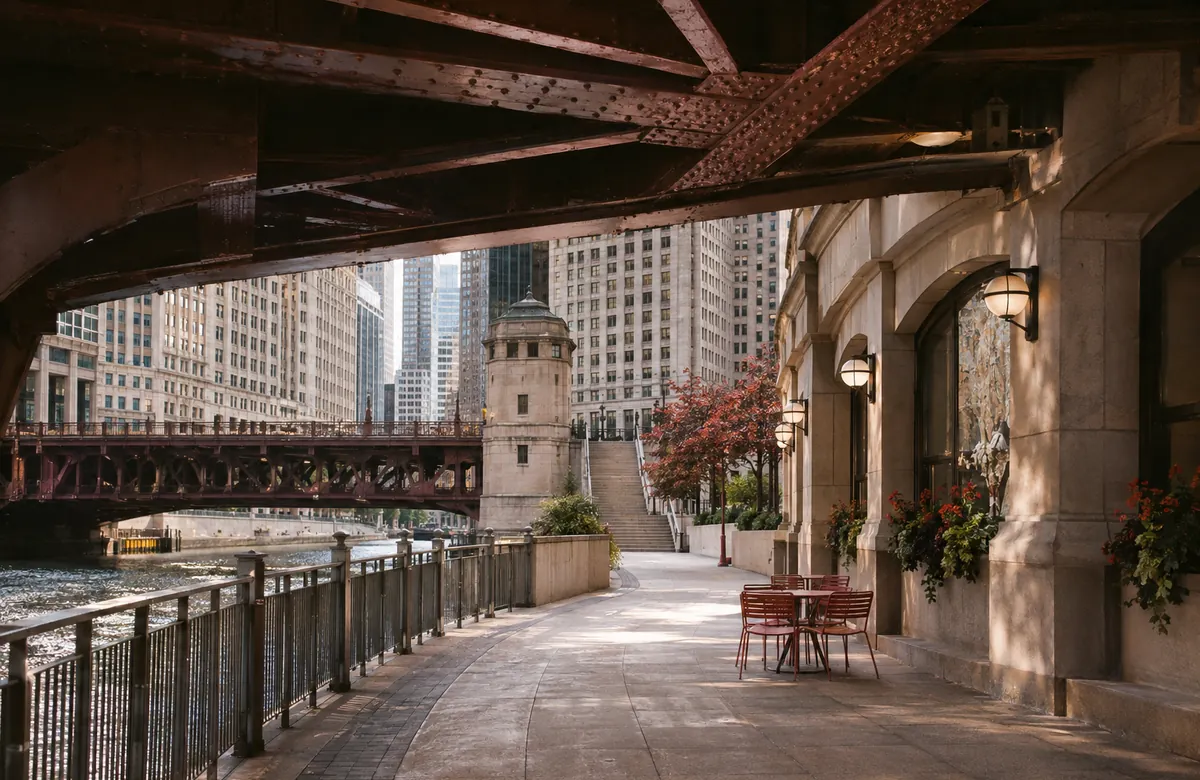
Most downtown Chicago walks begin with the problem of getting somewhere. An office worker chooses the side of a block with the fastest traffic light; a tourist searches for an entrance to a museum. A walk along the south bank of the Chicago River offers another possibility. At water level, the long line of bridges sets the pace. A traveler can stop to watch a boat negotiate a turn without standing in the way of someone waiting for a bus. The distance between the buildings suddenly matters as much as the buildings themselves.
The Riverwalk was not created from nothing. Pockets of river access existed long before its modern expansion. But Chicago completed the third phase of the project in October 2016, opening the stretch from LaSalle Street to Lake Street. City records describe the resulting promenade as roughly a mile and a quarter long. A series of disconnected waterfront destinations had become a linear public place with a distinct rhythm. Unlike a park surrounded by roads, it runs underneath some of the busiest roads in the city.
The city seen from a different height
The change in eye level does more than make attractive pictures possible. From an ordinary Chicago sidewalk, the ground floor of a large building often dominates the view. Across a relatively narrow street, the top of a tower may disappear from sight. On the Riverwalk, the width of the water creates visual distance. A pedestrian can study an entire facade, see how neighboring buildings compete for a corner or notice the little details around a bridge house. At the same time, the river's lower elevation emphasizes the bases of buildings and the immense practical weight of a bridge.
The undersides of the crossings are especially revealing. People using Michigan Avenue are accustomed to seeing a finished bridge framed by lamps and railings. Pass beneath and the structure tells a different story: steel members, machinery, rivets and signs of repair. Waterborne transportation and street transportation meet at an exact physical point. In Chicago, the meeting has shaped the downtown street grid itself.
It is an appealing place to take someone who knows little about architecture. A discussion about a tower's mass or its relationship to adjacent properties becomes much easier when the subject is visible at a reasonable distance. An architectural boat tour can offer excellent perspective; the pedestrian, unlike the passenger, can remain in one spot as long as desired and return in different weather.
The park inside the traffic network
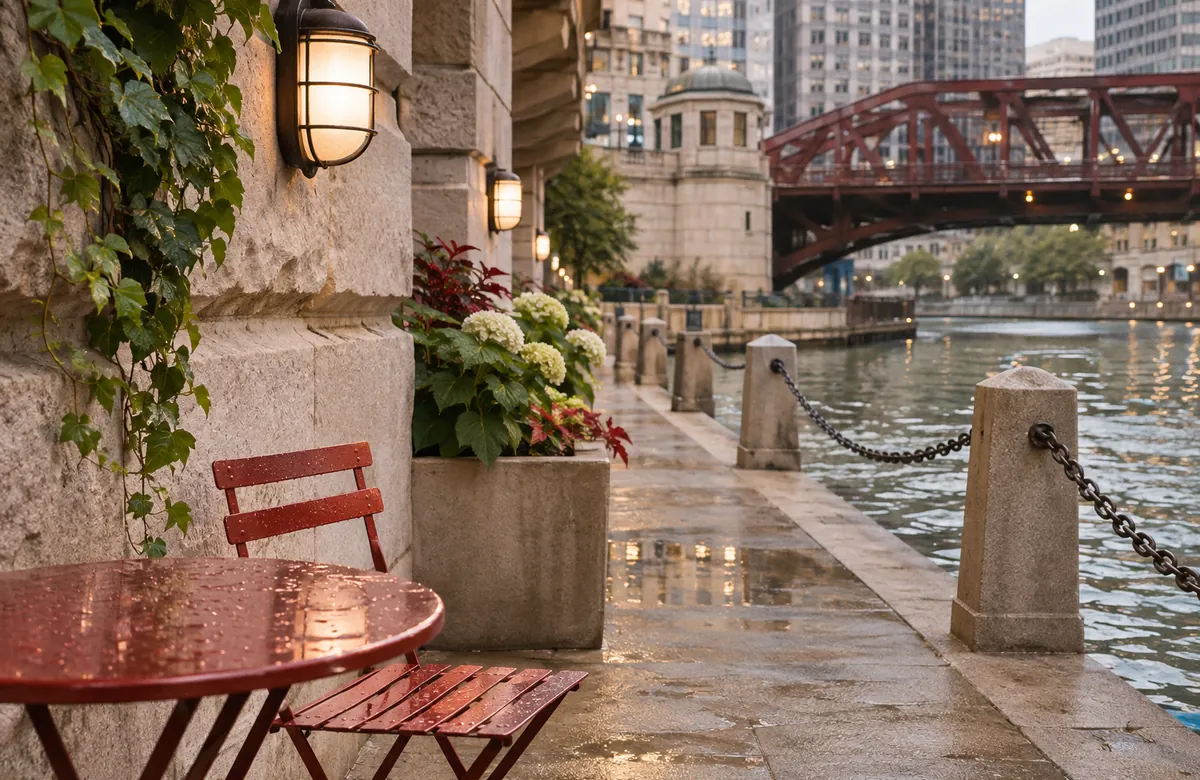
A path squeezed between a wall and a navigable river could easily have been little more than a functional sidewalk. The expanded Riverwalk instead provides small rooms, some broad enough to sit in and others intentionally narrow, with different seating arrangements and uses. These differences prevent the whole promenade from feeling like one extended commercial strip. Near a stairway or a place where the path widens, people can pause. Under the bridges, they pass through compressed corridors before emerging into daylight.
A successful narrow public place has to be predictable. A person heading to work should be able to pass couples looking at the water; a parent pushing a stroller has to negotiate both. A step overlooking the river can serve as a seat, but it cannot substitute for a level route. The importance of accessible paths between street level and the lower promenade is apparent when comparing a casual walk downtown with a visit planned around a mobility aid. Stairwells may be the quickest connections for some users and no connection at all for others.
The Riverwalk's success is partly about the mundane details that civic renderings tend to overlook. The pavement must withstand wet conditions. Pedestrians have to see where the edge of the path lies after dark. Service deliveries and waste removal should not block the only continuous route. A bench placed outside the main flow of traffic offers more practical comfort than a handsome bench everyone must walk around.
There is a useful comparison with the lakefront. The Lake Michigan shore provides a long route and generous expanses of open land, but it lies to one side of downtown. The main river branch reaches into the commercial center. From the river, a climb of one flight of stairs can put a pedestrian back into a completely different landscape. That possibility lets a visitor combine an ordinary errand with twenty peaceful minutes beside the water.
A public place with a business plan
Chicago's riverfront vendors help give certain stretches a recognizable character. A cafe can supply shade, tables, restrooms and the natural surveillance that comes with a busy place. A boat landing brings people who might not otherwise descend to water level. Restaurants have practical reasons to care about maintenance and access. Their facilities can remain useful long after the officials who cut a ribbon have left office.
Yet the commercial activity also raises a question that applies to many downtown improvements. Can someone enjoy the river without spending money? Good waterfront design preserves the right to stop, sit and wander outside the boundaries of a paying establishment. A promenade that is lovely but essentially requires a reservation will serve fewer people than a plain, well-kept linear park. The informal conversations that take place on unprogrammed steps and seats are part of the area's value.
Seasonal business makes that quality particularly important. Chicago's winter limits the time people spend outdoors; the visitor arriving in January cannot expect the same choices as someone stopping by in June. Even when concession windows are closed, however, the river never entirely loses its attraction. It is an unusually large body of moving water within a dense city. Fog, snow and reflected light can reveal more about its geography than a summer afternoon full of traffic on the water.
The river remains a river
Waterfront design sometimes treats water as a decoration. The Chicago River makes that fiction difficult to maintain. Boats have destinations. Rain can change conditions. Flow and water quality are matters of engineering as well as aesthetic judgment. Maintenance workers and transportation agencies perform tasks that most promenade visitors never need to think about. A pleasant afternoon at the water's edge depends on substantial infrastructure upstream and downstream.
That helps explain why the Riverwalk should be understood as a new chapter of the river's economic history rather than an attempt to erase it. For generations, construction, deliveries and industrial activity shaped the shoreline. The office towers and hotels facing today's promenade are themselves products of earlier decisions about land, transportation and engineering. The city has introduced a substantial new use without removing the evidence of the old ones.
A small riverfront detail can capture this contrast. At one crossing, a traveler hears the rattle of vehicles passing over steel; a moment later, the sound competes with voices from a group on the steps. An office worker may hurry up a ramp while someone seated nearby is making a drawing. None of these uses requires a grand civic program. The river connects them because it creates a common destination.
A useful change in perspective
Many local trips still depend on places that do not get the same attention as the center of Chicago. A beautiful riverfront improvement does not automatically create a welcoming bus stop in another neighborhood or a safe crossing beside a school. The reason to study the Riverwalk is not that its exact form can be copied everywhere. It is that the city recognized the value of treating pedestrian access as a continuous network and giving people somewhere to go without a fixed purpose.
After the 2016 expansion, a Chicago resident could add the river to countless walks without planning a special trip. Take the bank for several blocks, leave at a convenient crossing or return by the other side of downtown. For all the elaborate engineering involved, the result is a choice made every day in seconds. Instead of walking straight to the next appointment, go down to see the river first.