Someone visiting downtown Chicago with children acquires a different view of its parks from a visitor interested primarily in architectural monuments. The important details may involve the distance between places to sit and play, or whether the available activities suit a range of ages. A beautiful lawn is valuable, but the group might want to spend more time at a place where the landscape encourages movement in ways that are impossible on a conventional city sidewalk.
When Maggie Daley Park officially opened in December 2014, it helped introduce more of those possibilities into the central lakefront landscape. The park sits next to Millennium Park within the wider setting of downtown Chicago's public open space. Its initial opening included the skating ribbon, climbing features and play garden. The facilities provided reasons to visit distinct from the activities people already associated with the nearby gardens, performance spaces and artworks.
Maggie Daley Park is particularly interesting to consider in relation to its more famous western neighbor. Public spaces placed beside one another need not reproduce the same attractions in order to form a coherent landscape. They can serve quite different kinds of visits. Giving people more ways to remain outdoors for a substantial period adds to the overall usefulness of the park system.
The journey around a skating ribbon
The park's distinctive skating ribbon provides a useful example of the difference between the physical act of recreation and the experience of the place in which it occurs. A conventional skating rink is usually arranged around a simple open area. Skaters follow a predictable route, encounter one another repeatedly and remain in sight of much of the surface. A ribbon creates a different visual and spatial experience because the activity takes place along a winding path through the landscape.
Someone moving through such a space does not necessarily see the same surroundings at every point. The direction of travel, changes in the landscape and the presence of nearby people become part of the experience. A visitor standing alongside the route can watch skaters pass rather than looking across a single rectangular surface. The dimensions and arrangement of the place transform an otherwise familiar form of recreation.
The difference suggests why it is useful to think about public recreation through the relationships between landscape and activity. A feature does not become equally appropriate in every setting simply because people enjoy doing something there. A large open rink might work very well in one park. In another, the opportunity to move through a landscaped setting surrounded by downtown architecture offers something unavailable in an enclosed facility. The activity makes the shape of the place evident to the person taking part in it.
The design also brings ordinary practical responsibilities. A route used by people moving at different speeds needs appropriate guidance. A visitor waiting for a companion requires somewhere to stay out of the way. Equipment, surface conditions and supervision influence whether the intended recreational experience is available on a particular day. The pleasure of an appealing layout depends on considerable attention to operations, particularly during periods of intensive use.
Rooms without roofs
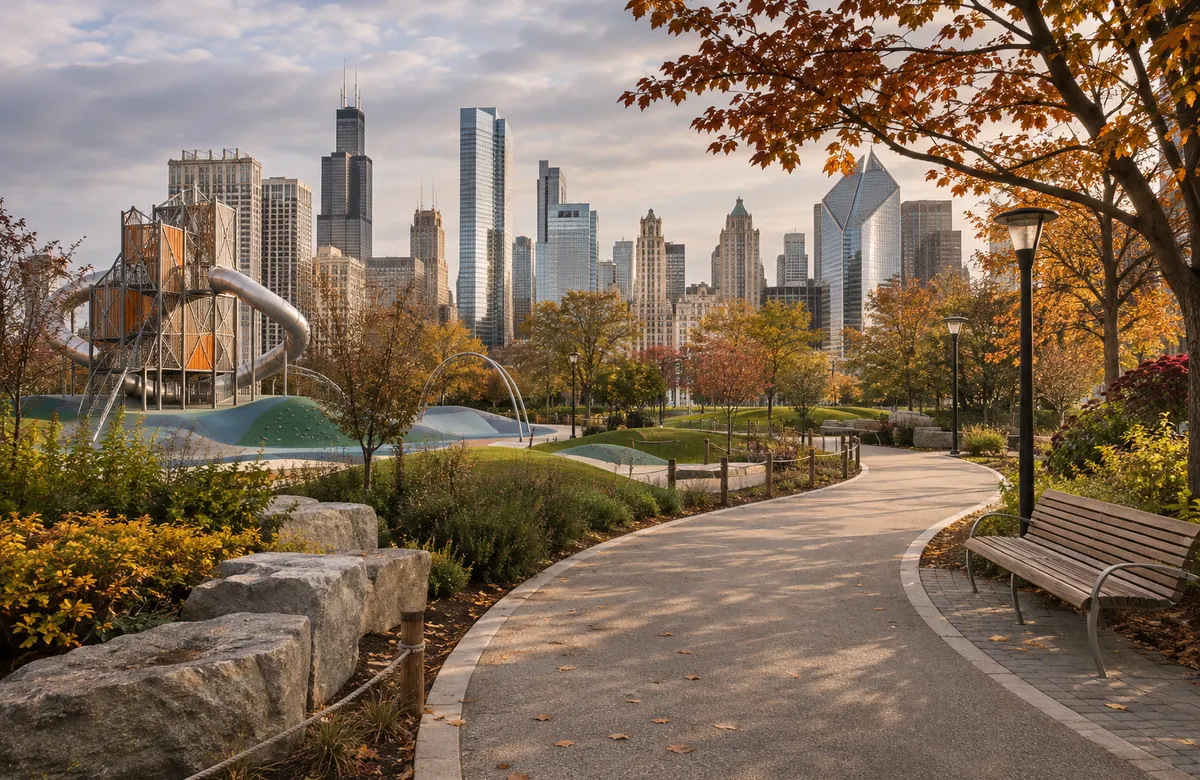
Maggie Daley Park's play areas use landscaping and built structures to distinguish places that would otherwise be part of one expanse of public land. A child approaching a play feature encounters a transition from an ordinary route to a space arranged around a different kind of movement. Changes in elevation, the forms of individual structures and the relationship to neighboring areas provide reasons to investigate rather than merely proceed in a straight line from one attraction to the next.
The organization of those places affects adults as well. A group of people accompanying children may need to remain within sight of a certain area without continually occupying the structures themselves. Places to sit become especially important during a long visit. The distribution of entrances influences how easily a family can pass into a new area. The transition between locations where children move freely and those where other travelers pass nearby needs to be clear.
These are ordinary details whose significance is greater than it might first appear. A family that has traveled to a large downtown park often wants to remain for a considerable period rather than deciding that a fifteen-minute visit will suffice. The adults' ability to rest and maintain a comfortable connection to the children may determine the practical length of that outing. The park must accommodate the time spent between the principal activities as carefully as it does the activities themselves.
An effective playground offers choices rather than presenting an obligatory sequence of tasks. Children of different ages and interests can select what they want to try. Someone who prefers imagining a story to attempting a complicated climb should find opportunities to play without becoming involved in an activity designed for a different set of skills. The possibility of independent decisions helps make a recreational landscape appropriate for repeat visits.
The park where several schedules coincide
Large downtown parks have users whose purposes are often quite unrelated. Some come to make a deliberate visit to a particular attraction. Others pass through as part of a walking route. A person with an hour available before a meeting may want a peaceful place to sit. Someone else wants to spend much of the afternoon on an activity requiring considerable movement. The available spaces influence whether these visitors can coexist comfortably.
For this reason, generous connections between different areas are as significant as the major attractions themselves. Paths that lead abruptly to a busy recreational space can become congested when people stop to examine what is happening. More than one route through a park allows travelers with different destinations to distribute themselves naturally. Somewhere to pause outside the principal lines of movement makes lengthy visits easier without interrupting those who intend to continue walking.
The position of Maggie Daley Park beside other well-known public spaces expands its possible role in a downtown visit. A person can spend time among the activities in the park and then devote part of the remaining day to another destination nearby. People who are not interested in a particular form of recreation still have reasons to walk through the area. This variety matters especially when a group contains people who would otherwise plan quite different kinds of outings.
There is also an intriguing relationship between the landscape and the buildings visible from it. In large neighborhood playgrounds, the immediate surroundings may be largely residential. Here, tall downtown structures remain visible from many points. Children can play in an environment surprisingly distinct from the streets around the Loop without losing the visual evidence of the city outside the park. A recreational visit becomes a particular way of experiencing that larger urban location.
What a park has to provide every year
The ambitious design of a public recreational facility creates expectations that continue well after its opening. Surfaces wear through use, moving elements and structures require inspection, and plants need attention. Seasonal operations require workers and equipment. The value of the original investment can diminish quickly if the facilities become unavailable to the people interested in using them. A simpler park left in consistently useful condition can be preferable to an elaborate one whose attractions are frequently inaccessible.
A public park also remains open to changing interests and patterns of use. Visitors may discover combinations of activities the designers did not anticipate. Some places become popular routes even if they were not intended to receive such frequent traffic. Observing what residents and visitors choose to do provides information about which features justify continued investment and which are less effective than originally expected.
Chicago's investment in Maggie Daley Park is a reminder that the suitability of a downtown landscape should not be assessed only through its appearance from surrounding buildings. It matters whether a visitor at ground level can spend an interesting afternoon without exhausting the available pleasures too quickly. Children and adults can have quite different reasons for appreciating the place, and a well-connected landscape gives all of them opportunities to choose a route. The achievement of the park opened in 2014 was to introduce more occasions for active recreation within a portion of the city already known for its public open space. The work of sustaining those occasions continues with each season of ordinary visits.