
A reader sitting down with a printed magazine encounters an arranged object. The cover promises several stories, the opening pages establish a voice, and the larger assignments receive room. An essay that would look minor in a list of links can become indispensable because of its position beside a photograph or another writer's work. The sequence is an editor's decision. It remains legible even when the reader has no intention of proceeding through every page in order.
The first generation of tablet magazine experiments often tried to preserve the appearance of the printed issue on a different screen. The effort demonstrated that an elaborate layout could travel in an application, but it also made the problem of navigation apparent. An article could require awkward zooming; returning to a particular paragraph might be difficult; an expensive production process could produce a beautiful object that remained inaccessible to someone without the application. Digital editions need to retain some of the editor's arrangement without reproducing all the properties of paper.
The website offers a second model. Every piece can become a permanent page, readable alone and discoverable through a search or a friend's recommendation. That independence is valuable. It may also dissolve the issue into an endless succession of posts. The reader no longer encounters the reason an editor assigned two essays at the same moment, because the pieces have been scattered into different corners of the site. A magazine can offer both an individual article and an issue that explains the larger editorial intention.
A theme is an editorial relationship
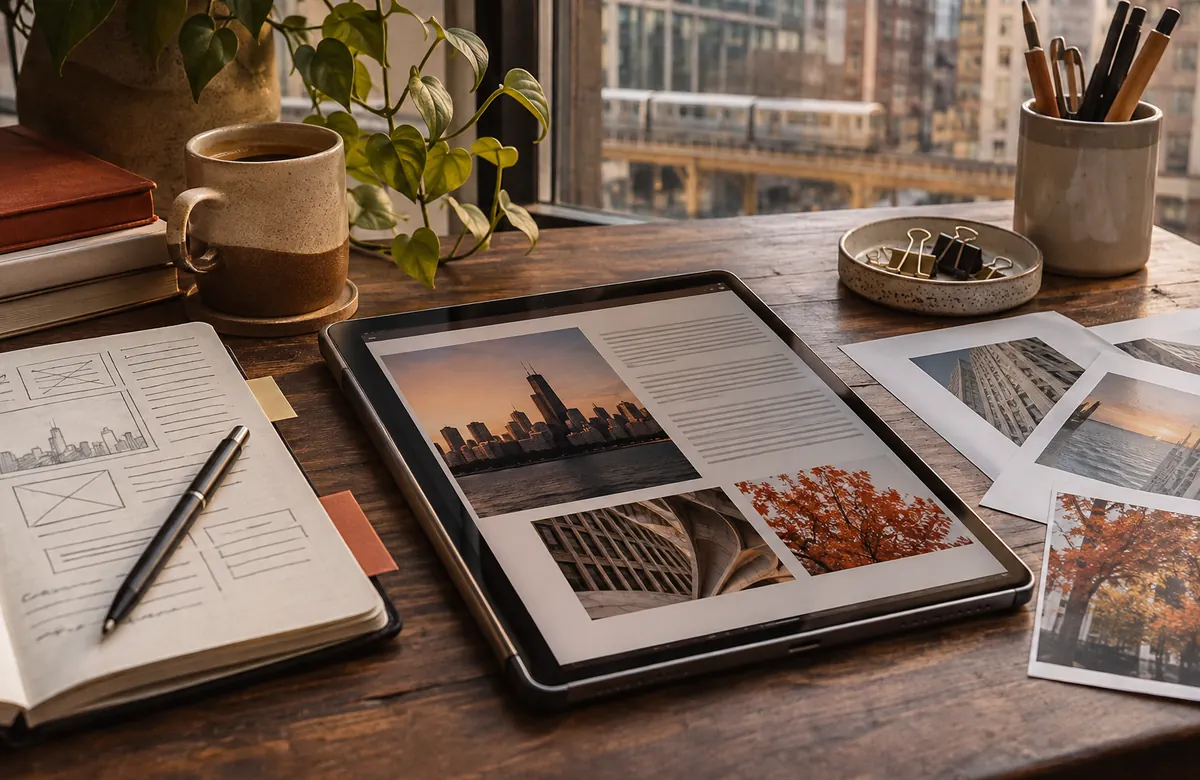
Consider an issue of a fictional Chicago magazine devoted to the city's changing waterfront. One reporter follows a public construction project. A photographer documents the existing shoreline. An essay looks at the history of recreation on Lake Michigan. Those assignments have different methods and answer different questions, but placing them together gives readers a way to understand what is changing. The issue does more than declare a theme. It assembles distinct evidence and perspectives on a subject that none of the pieces can exhaust.
A digital cover can explain that relationship. It might establish the location and the period being examined, then introduce a handful of stories with descriptions written specifically for the issue. One essay may serve as a natural entry point because it provides earlier history. The photography can follow it, showing details that the text mentions. Readers can still select any piece immediately. The editorial sequence serves as an invitation rather than a technical restriction.
The editor must guard against assigning a whole issue to a theme that does not sustain it. Three substantial stories about the same narrow subject may offer more insight than twelve overlapping pieces. A slim edition leaves space for people to consider what connects the articles. Other coverage may continue elsewhere in the magazine. An issue should make a specific part of its work intelligible, not require every editorial decision to repeat the same vocabulary.
Pages have their own lives
Each story needs an address that survives after the next issue appears. A visitor arriving at a review from a search should understand where it fits within the magazine, which publication is responsible for it and when it was written. That visitor may be unfamiliar with the context of the waterfront issue. A small label identifying the issue and a relevant link to its table of contents can supply what the visitor missed without requiring the article to begin with a lengthy description of the whole package.
A well-designed table of contents gives the articles an additional route to discovery. It differs from a category page because it documents a moment of editorial judgment. The category may eventually contain hundreds of pieces published over several years. The issue is a finite selection whose meaning depends in part on the moment of its publication. Both structures matter. An archive of issues lets a researcher see the subjects that occupied the publication during a particular season. A category gives that person a route to comparable work from before and after the issue.
Editors should retain both even if an article's appearance changes. When a new design replaces the original page layout, the record of the issue can survive as structured information. Store the issue title, date, description, article addresses and intended order rather than relying on a fragile picture of an original cover. A screenshot can supplement the record of the design, but it is not a usable substitute for accessible text and independent stories.
Art can lead, but it has to carry meaning
Digital design provides space for excellent photographs. At the opening of the waterfront issue, a wide image of the shore can establish the location more quickly than a long text introduction. Elsewhere a portrait or a close view of a physical detail may supply evidence necessary to understanding a particular story. Their different jobs should determine their size and placement.
The same photographs need to work on small screens. If the designer crops a wide photograph for a phone, the crop should retain the significant subject. A caption must identify the location and explain whether the picture depicts an event reported in the article, an earlier moment, or an illustration. Photographs selected purely for size tend to lose importance as screens change. An image chosen for its informational or expressive contribution can remain meaningful even when displayed modestly.
Typography and empty space are among the cheapest means of distinguishing articles. A long investigation can begin with a restrained introduction and proceed through clear sections; a short column may need little more than a headline, date and text. A single template can accommodate these differences. Designing a new technical system for each story creates maintenance difficulties that outlast its moment on the cover. The editor should reserve complex interactive pieces for material that genuinely depends on the form.
Give the issue an ending
An unbounded home page encourages readers to continue indefinitely. An issue promises a finite collection. That promise is particularly useful for readers of cultural journalism, who may set aside a period on the weekend to read a magazine rather than search for one answer. An issue page can identify each article, present a selection with recognizable scope and make the boundaries apparent. The reader can finish it, leave and know that no mandatory continuation remains.
The boundaries also help the newsroom manage production. The articles need not all be finished on the same day, but the published issue should not rely on unannounced gaps. If a piece remains forthcoming, the magazine can identify it as such. If a major assignment is delayed, the editor should consider whether the issue can stand without it. The freedom to update a digital publication does not eliminate the need to decide when a collection is ready.
Some subjects require corrections or later developments. A note on the issue page can direct readers to reporting published after the collection, while the original issue remains identifiable. Replacing the most visible old story with a new article and leaving no record confuses history. The distinction between an edition as published and continuing coverage of its subject is worth retaining.
A format worth maintaining
The appeal of the digital magazine lies partly in its ability to connect works that were produced at different times and discovered through different routes. A thoughtful issue does that work explicitly. It can bring a short observation into conversation with a long piece of reporting, and make a series of images available to someone arriving from either article. It gives the publication a recognizable shape without making the reader dependent on a particular device.
A modest newsroom can build this experience with a reliable set of article pages and a small number of carefully edited collection pages. It does not need to simulate the turning of paper or require an application installation. The expensive part is choosing work worth placing together. Once that work is done, the design should preserve the relationships among the pieces and make them available to the people who arrive one at a time. That is one of the editor's oldest responsibilities, adapted to a publication without a binding.