A photographer sends twenty pictures for an article on a Chicago art exhibition. The editor chooses two, changes their dimensions for the site and saves the published versions beside a folder of drafts. A year later, a colleague working on the artist's next exhibition finds one of the pictures. The file name contains no caption and no photographer's name. Several similar files circulate in the newsroom. Nobody remembers which one was the original or whether the publication received permission to use it again.
That ordinary problem is the starting point for media asset management. The publication does not have to own an elaborate digital library to address it. It does need a way to bring together the material, the information that explains it and the terms on which it can be used. The approach can begin with a modest shared directory and expand as the work accumulates.
Begin with one point of arrival
Select a location where incoming media is stored. Photographs scattered between private message threads, personal cloud folders and editors' laptop desktops will be difficult to locate once a story has been published. A designated incoming area provides a place to review material and decide where it belongs.
Require a short description of an assignment and the contributor. The description might identify an exhibition, an interview, a public space or a meeting. Add the date the material was recorded when it is known. Distinguish that date from the date the files were delivered and the date the work appeared online. For a photograph shared many years after it was taken, all three dates can differ substantially.
Do not infer the original date entirely from changes shown by a computer's file manager. Files can acquire different dates when they are moved, recovered, modified or downloaded. Camera metadata may be helpful, but cameras also have clocks that have been set incorrectly. If the date is significant to the story, confirm it using the photographer's records and other contextual information.
An initial review should also establish what is missing. Perhaps the editor has a caption for a group portrait but nobody has identified the people in the back row. Record verified information and the outstanding question separately. Future staff will be better served by an explicit gap than a confident description of the wrong people.
Give ordinary files meaningful names
An original photograph may arrive with the number assigned by a camera. Leave that name visible in the internal record, but give the archive copy a clear identifier. A name that connects it to an assignment makes it easier to recover manually when a search interface is unavailable. Avoid descriptions that become inaccurate every time an editor changes the use of a picture.
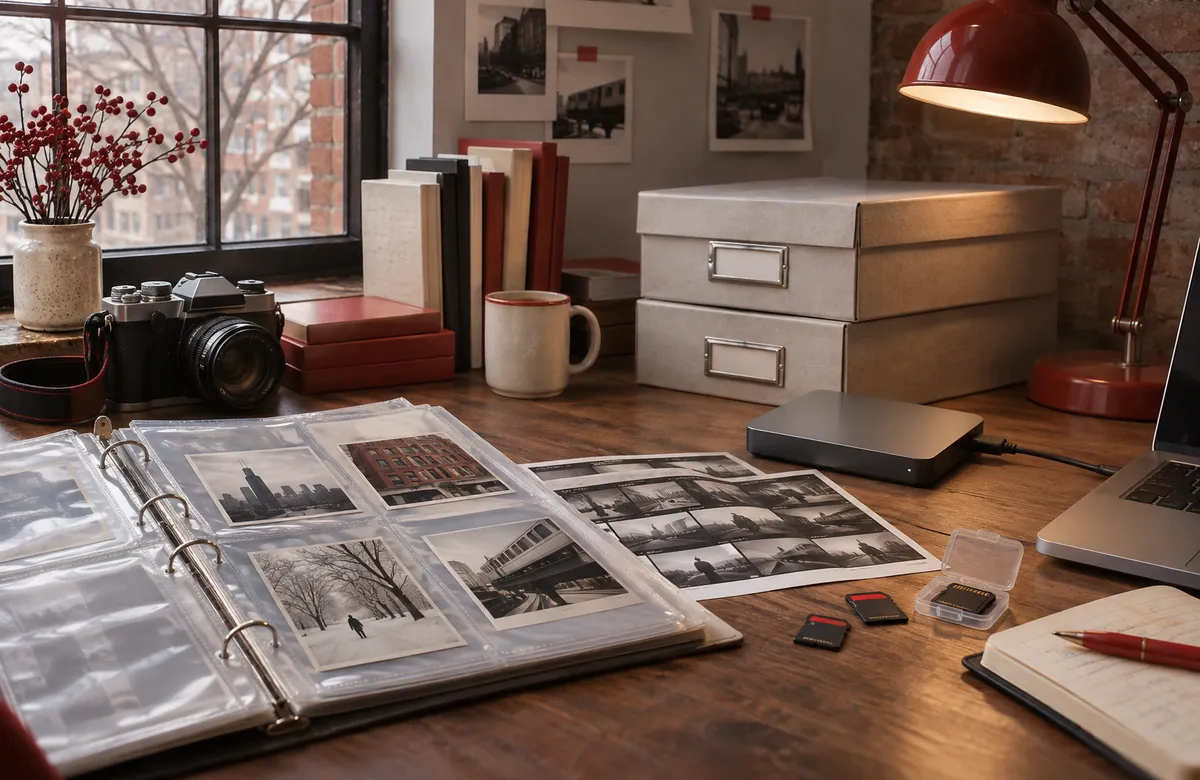
For the archive, maintain a distinction between the original camera file and derivatives created for different publication layouts. A cropped web image is not a substitute for its source. A square thumbnail may omit a detail that mattered in the original scene. A print version may incorporate adjustments intended for a different medium. Keep their relationships apparent.
For a small publication, a record might consist of the master asset identifier, the description, a contributor name, dates, a rights entry and the identifier of the corresponding story. Each derivative can refer back to the same master asset. If you change the image processing requirements next year, you can create new derivatives from the preserved originals instead of editing files repeatedly until details disappear.
Choose a naming convention people can follow under deadline. The publication gains little from an ambitious taxonomy if only its inventor understands it. A consistent assignment identifier and stable asset number may be sufficient. The archive record can supply more descriptive information than a file name can reasonably contain.
Rights and credits belong beside the file
The person who has a copy of a photograph does not necessarily own the right to publish it. A photographer may authorize use for one story. An institution might supply publicity photographs for coverage of an exhibition. A staff member may have downloaded a public image under terms that require a particular credit. These arrangements are not interchangeable.
Keep the terms of permission with the record of the asset. Note who gave permission, the specific material covered and any restriction on reuse. Preserve the original correspondence in an appropriate internal location. If the rights are unclear, set the asset aside rather than treating the fact that it occurs in the archive as evidence of authorization.
Maintain credit information even for pictures that the publication produced itself. A contributor should not have to establish their authorship again every time an old story is resurfaced. The credit can also help an editor trace questions about the setting, date or subjects of an image.
Do the same for music, sound recordings and video. A file used under the terms for one production may not be covered when somebody prepares a different program. A careful asset record allows an editor to examine the terms before planning a new project around material that may not be available for it.
Write captions for a person who was not present
The caption is frequently the most useful part of an archived image. Include what the viewer needs to know beyond what is visible. For a picture of a performance, identify the production, the venue and the performers where those details are confirmed. For a news image, say what happened, where and when if known. Distinguish a posed portrait from the photographic record of an event.
Store a caption as editable text linked to the asset. A caption embedded only in a web page becomes hard to recover when the page is deleted or the publication changes its design. The archive record should survive those changes.
The text used as a description for users of assistive technology may require a different emphasis. Consider the meaning an image conveys in the specific story. The description for a photo of a mural in a neighborhood article might address the subject and physical setting, while the visible caption provides the artist's name and date. Neither should contradict information represented by the other.
Review metadata before preparing a public copy. A camera may record geographic coordinates and device information, and other software can add more detail. Preserve relevant internal information appropriately but exercise judgment over what a public derivative discloses. A photograph of a private space may not be suitable for publication with its precise recorded location.
Plan for storage failure
An archive sitting on a single external drive is vulnerable even if it contains thousands of carefully named files. Devices fail, go missing and get erased. A shared service can also suffer mistakes: one user may delete a folder that an entire publication depends on.
Keep independent copies, with appropriate access controls, of the material the publication needs to preserve. Make sure that the backup includes the asset records and rights documentation, not only the large media files. Test recovery of a modest assignment folder rather than simply trusting an indication that synchronization has finished.
The Library of Congress publishes information on digital formats and their suitability for long-term preservation. A small publication may not have the resources of a national library, but it can still benefit from the underlying principle: choose formats that can be read and supported over time, and do not rely exclusively on an opaque application to interpret the archive.
Review the oldest portion of the archive periodically. An obsolete storage device or a collection of files that nobody can open is easier to address before the last working device or compatible software disappears.
It is difficult to keep a complete record of a city's ordinary life. Even a focused neighborhood publication accumulates images of places before renovation, performances that took place once and people whose stories may otherwise be hard to locate. The useful archive starts during the ordinary work of reporting, when dates, names and permissions are easiest to establish. Years later those small records will be worth much more than another folder of unlabeled pictures.