A photograph of an ordinary Chicago street can puzzle its viewers in interesting ways. They may recognize a particular branch of a business that has since moved, yet be unable to explain what drew the photographer's attention to the entrance. The light could have been unusual. Somebody standing just outside the door might have reacted to somebody else. An arrangement of things that would separate a second later has been given a permanent form. Investigating this kind of photograph requires attention to relatively small matters.
The posthumous emergence of Vivian Maier's work made that activity unexpectedly accessible to a wide audience in the 2010s. Photographs that had remained private for decades appeared in exhibitions and books, where viewers could discover both an individual way of seeing and substantial amounts of information about the places in which Maier worked. Chicago was one of the most important of those places. The city's history became a quite unintentional subject of many of the photographs.
The discovery of an extraordinary body of work
Maier moved to the Chicago area during the 1950s. Her work as a nanny enabled her to spend periods of time observing both the city and its suburbs, where she made numerous photographs. Her extensive output included black-and-white and color images and other material. Part of that archive passed into new hands through an auction in 2007. Her death in 2009 preceded the development of public enthusiasm for her photography.
The unusual circumstances of the pictures' discovery can seem almost as intriguing as the images themselves. They raise important questions about how photographs come to be known, which portions of a collection are made available and the way a public conception of a photographer's distinctive interests develops. A viewer encounters an extraordinarily small fraction of Maier's total work in any individual exhibition. The decisions made by the people preparing that exhibition help define the photographer the audience subsequently thinks it knows.
In 2014 Chicago Public Library exhibited a selection of Maier's photographs at the Harold Washington Library Center. The show consisted of silver gelatin prints and encompassed street photographs and images she made of herself. The breadth of the material offered an opportunity for viewers in her longtime home city to consider the career of someone who apparently had never depended on developing a recognizable public reputation as a photographer.
Maier's work gains considerably when considered as the product of a long practice. A single remarkably timed image may be the result of a photographer happening to stand in the right place just as somebody turns a corner. Over a much larger number of photographs the distribution of such moments begins to indicate things about the person's attention and preferences. The chance occurrence becomes something the photographer has learned to recognize as it is taking shape.
Looking for more than the main subject
A street photograph may contain very little of what a photographer would ordinarily describe as a subject. One pleasure of studying it is exploring areas of the frame whose significance is not immediately apparent. A small hand in one corner might help establish the direction of movement across the picture. A mirror in the street may show the presence of people whose bodies remain invisible in the rest of the image.
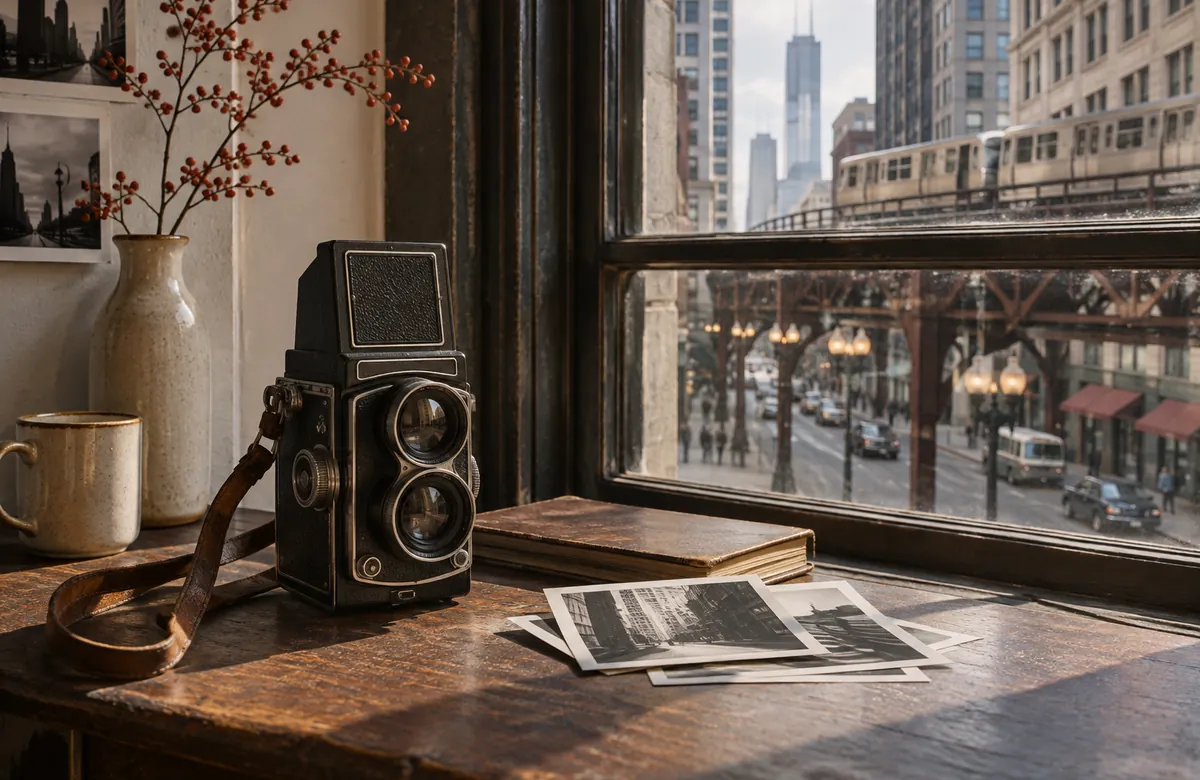
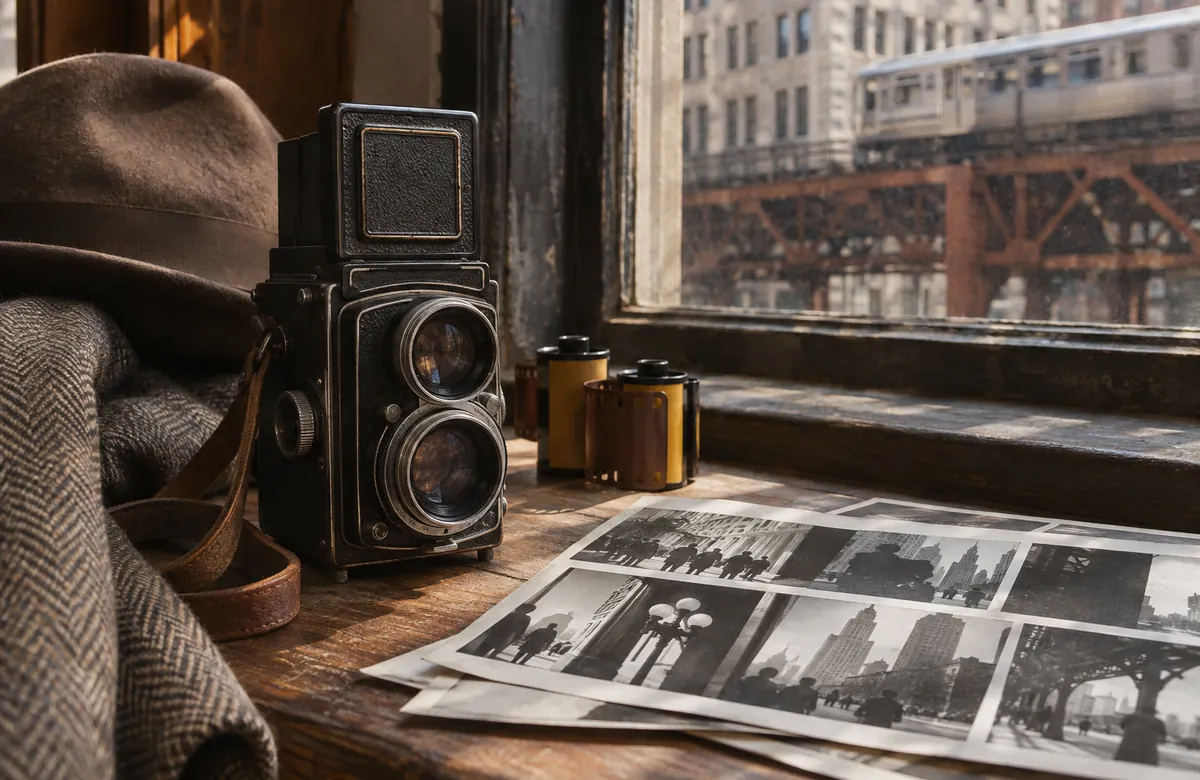
Maier frequently made photographs with a twin-lens reflex camera. The arrangement of its viewfinder encourages the photographer to look down at the image when making a picture at waist level. This can bring quite different possibilities from raising a conventional camera to eye level. A slightly lower viewpoint changes the relationship between people in the foreground and buildings behind them. A person looking elsewhere may be less acutely conscious that the photographer's attention is directed at them.
Her self-portraits provide another complication. The person taking the picture can appear as a figure reflected in a shop window or mirror without the street itself disappearing as a subject. The image becomes evidence of the photographer's position and activity rather than a view of a world from which the photographer is conveniently absent. The multiple visual planes of an ordinary reflective surface introduce a possibility for a work to be both a depiction of its surroundings and an investigation of how those surroundings can be depicted.
This can be a useful exercise for anyone interested in taking photographs. Look at an existing photograph without seeking to reproduce its most conspicuous effect. Try to reconstruct the painterly balance between its light and dark areas, the amount of empty space left above a person's head or the angle at which the photographer has viewed a particular surface. These seemingly mechanical considerations yield information about why the finished image communicates something about its subject.
What the history museum sees in a photographer
In 2020 the Chicago History Museum acquired approximately 1,800 color negatives and transparencies by Maier. Part of the material concerns her life in New York; an extensive portion depicts Chicago and the surrounding area. The museum subsequently made photographs from the collection available as part of its exhibition work. The acquisition provides an exceptionally clear illustration of the difference between the value of an image as an individual work and the value of a collection as a record of a place over time.
A building in the distance may be recognizable to someone studying the development of a street. A sign advertising a film can help establish approximately when a photograph was made. Clothes, street maintenance and vehicles record ordinary historical practices that are inconsistently represented in pictures selected to commemorate significant events. The material can become useful to people whose primary interests do not involve artistic images at all.
Photographers cannot plan for all the uses of that sort. A person photographing the exterior of a business may consider the composition's most notable feature to be the shadows cast on the sidewalk. For a researcher decades later, the frontage of the building before it was remodeled might be the only part of the photograph they have any particular desire to examine. Both are legitimate responses to the image.
It is easy to overlook that possibility while making photographs in a contemporary city. A building you see every day feels of little value as evidence, precisely because it currently forms such a familiar part of the street. The newsstands, parking kiosks and commercial signs of the present day may become equally interesting sources of information when changes make their presence seem less inevitable.
Photographing the people who share the city
An unexpected encounter with the beauty of Maier's images need not lead a visitor to accept any possible approach to photographing strangers. A street is a public environment shared by people having very different experiences. Some people may enjoy the attention of a photographer; others may be made seriously uneasy by it. The fact that a picture can be made from a public place is a poor substitute for thoughtful consideration of what its publication could mean to the person depicted.
Contemporary photographic technology makes these considerations more urgent. A digital image can be reproduced quickly, combined with information not present in the photograph, and circulated far from the place of its making. Instead of imagining that every interesting arrangement of people demands a picture, develop ways of showing the city without exposing someone to an unreasonable amount of attention. Take time to consider how a picture represents the relationships between the people in it.
Chicago still offers the strange abundance of visual events that makes Maier's pictures so enjoyable. Someone practicing photography can spend hours on a familiar street and discover how rarely they previously watched the changing light on a window or the turn of a person's hand. The most useful result of exploring photographs like Maier's may be acquiring the habit of sustained attention to ordinary scenes, even during the portion of the day in which your own camera remains in a bag.