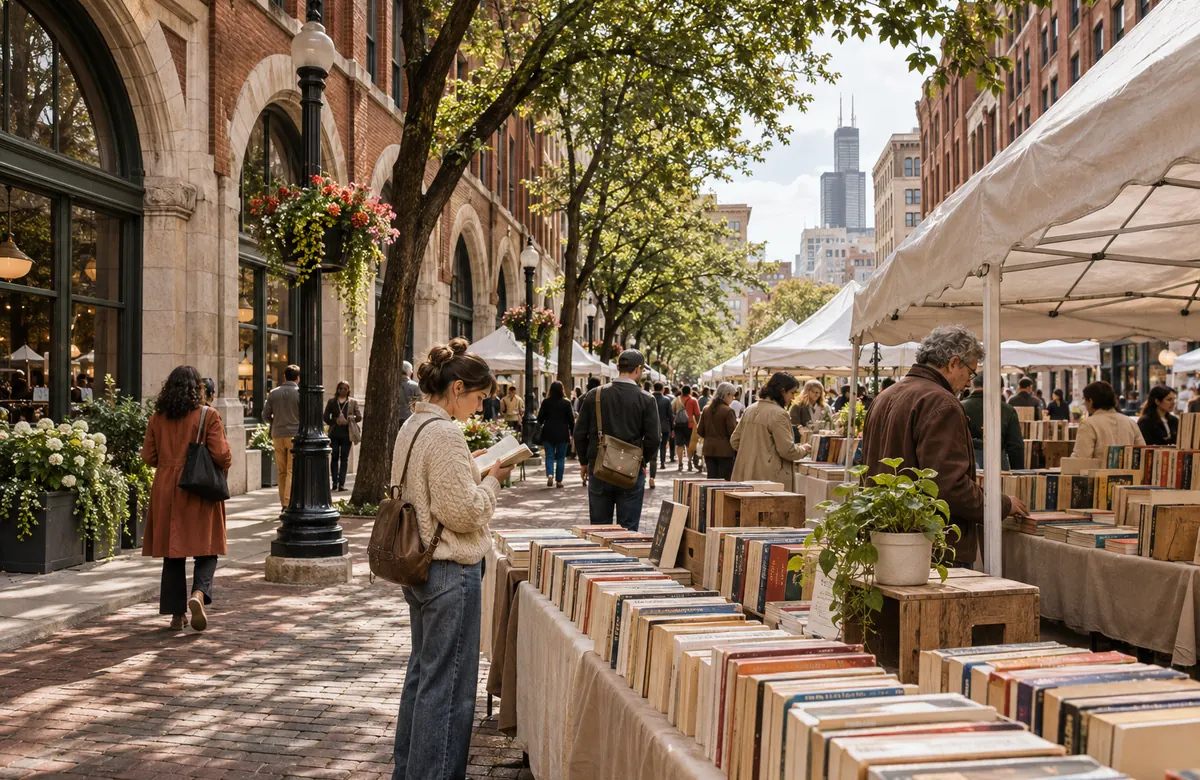
A book fair is a very peculiar form of retail. Customers handle some of the merchandise for a long time without deciding to buy it. They may come looking for a book whose author or exact title they do not remember. Instead of leaving a stand when they discover that it does not have the expected item, they sometimes begin investigating the other books around it. By normal shopping standards the entire process is rather inefficient. That is a considerable part of its value.
Chicago's Printers Row Lit Fest provides a setting for this kind of exploration. Booksellers, independent publishers, established authors and readers use the neighborhood for a public literary gathering. Its name refers to an earlier concentration of businesses concerned with printing and publishing in the South Loop. The festival's own history is part of a later effort to give that part of the city a different economic life.
From printing district to public gathering
Printers Row owes much of its architectural character to the particular needs of publishing businesses. Maintaining the equipment and materials of printing required substantial commercial buildings. Chicago's important place within the national transportation network made the movement of paper into the city and finished printed material out of it relatively efficient. The neighborhood acquired a kind of industrial specialization whose effects remained visible even after the nature of the businesses changed.
In 1985, the Near South Planning Board launched what was then known as the Printers Row Book Fair. The event accompanied the redevelopment of an area with commercial buildings increasingly adapted for residential purposes. Bringing large numbers of people into the neighborhood for an event connected to its former industrial activity gave the books an unusual physical context. Instead of arranging an entirely separate site for a festival, it was possible to invite visitors to explore streets whose associations with the material preceded the festival.
By the time the fair had become a regular annual event, books could no longer represent the economic basis of most of the buildings that framed it. A visitor encountering the stalls could nevertheless consider how many different sorts of work had gone into the making of each volume. The writer's name is usually the most conspicuous element on a modern book. The people responsible for its design, printing and distribution have occupations that are much less apparent after the physical object looks complete.
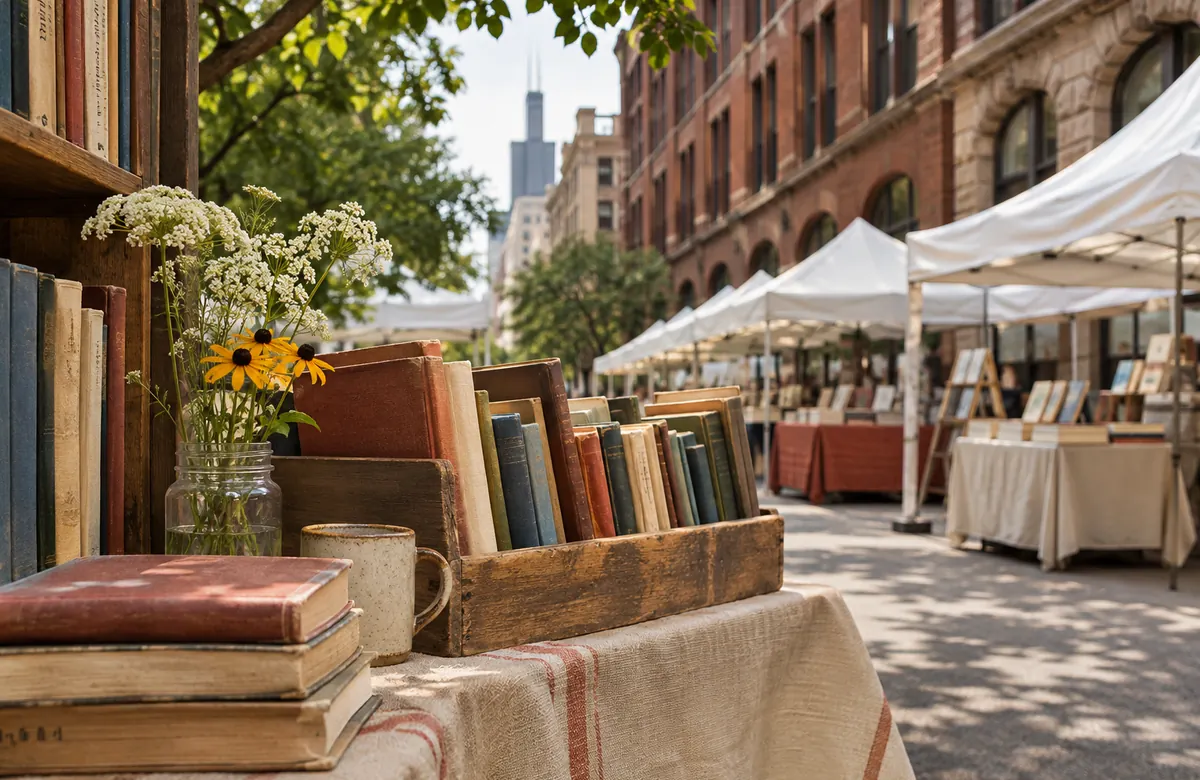
It is instructive to look at the blocks from the perspective of an earlier printing business before seeing them as a residential area. Notice the arrangements of large windows and doors. A building designed for people handling heavy equipment may have features not ordinarily needed in an apartment building. The adaptability of the structures is a reasonable explanation for their survival and for the character of the current environment in which the fair takes place.
The economic circumstances of a literary event
The organization of the festival has changed over the years. The Chicago Tribune operated it for a substantial period that began in 2002. Following the change in stewardship in 2019, the Near South Planning Board resumed responsibility. COVID-19 prevented the event from proceeding in 2020, and it came back in September 2021. In 2025 it celebrated four decades since its founding, providing a useful occasion to consider both the stability and the changing circumstances of an annual event centered on printed material.
A festival needs a range of participants whose purposes differ considerably. A specialist bookseller can justify attending if there's reason to think that people interested in the material will arrive in sufficient numbers. A small press may find the chance to meet a substantial proportion of its regional readership especially valuable. An organizer needs to provide for the requirements of vendors and visitors while also assembling public programs sufficiently interesting to draw people who have not previously attended.
At first it seems reasonable that selling books online should have made a large public book market less necessary. It is certainly easier to find a copy of a clearly identified book without traveling to dozens of stores. The advantages of the fair appear when someone knows only the outlines of their own interest. They may have heard about a particular piece of Chicago history, for example, but not yet know who has published something particularly illuminating about it. A person who already works with books on Chicago history can respond to a fairly imprecise description of what the visitor is looking for.
The combination of casual conversation and available objects makes these encounters worthwhile. An unfamiliar book can be opened quickly to a sequence of pictures, the bibliography or a representative page of the author's prose. Anything in it that strikes you as particularly appealing can immediately become part of a conversation. That is sometimes a faster way to select a good book than reading an extensive set of short, anonymous customer reviews somewhere else.
Finding smaller publishers
One of the most inviting aspects of a large literary fair is the opportunity to investigate organizations whose books rarely arrive at the front of a general-interest bookstore. A press may have carefully developed a relatively short list of books over several years. Putting those titles side by side makes the editorial concerns of the people responsible for the list apparent. Someone particularly interested in one of the books may discover an author previously unknown to them on the adjoining table.
Independent presses frequently depend on developing a public understanding of their distinctive interests. They may publish contemporary poetry, translations of work from elsewhere or books with a local connection too particular to seem useful to a major commercial house. The readers who come to know a handful of titles sometimes provide a substantial proportion of the audience for the next book. A festival permits the publisher to establish those relationships in person with readers whose interests have previously been difficult to identify in any systematic way.
The fair can also provide a glimpse of the practice of writing. Public readings and discussions allow authors to describe how the material came together, including occasions when the experience of doing the research changed their view of the book's subject. Someone interested in writing a Chicago-based work can learn a great deal from such conversations before having produced enough of their own material to discuss with a potential publisher.
Leaving time to browse
It is easy to spend most of the available time at the fair pursuing scheduled appearances by a few familiar authors. These can be enjoyable, but an hour of walking slowly among the tables may result in just as many valuable literary discoveries. Consider making arrangements to hear one or two people whose work you know well and devoting some time to authors you have never read. Their discussion may present writing as an activity very different from the one you know through your usual favorites.
If an author is speaking shortly, it may help to investigate a copy of the book beforehand. Notice a particular part that suggests a question. A writer who has spent a substantial period of time addressing a particular subject is an especially interesting person to ask about difficulties that arise when an audience tries to understand that subject. An informed question from one reader can help an entire group acquire a better understanding of the writer's work.
Books chosen at the fair have an unusually tangible setting in many visitors' memories. One cover brings to mind the brick buildings behind the seller's stand. Another book recalls a discussion with someone who had spent years collecting a particular kind of printed material. The work of reading is ordinarily quite private. A book festival in a former printing district enables us to experience some of the history and social activity that make that private pleasure possible.