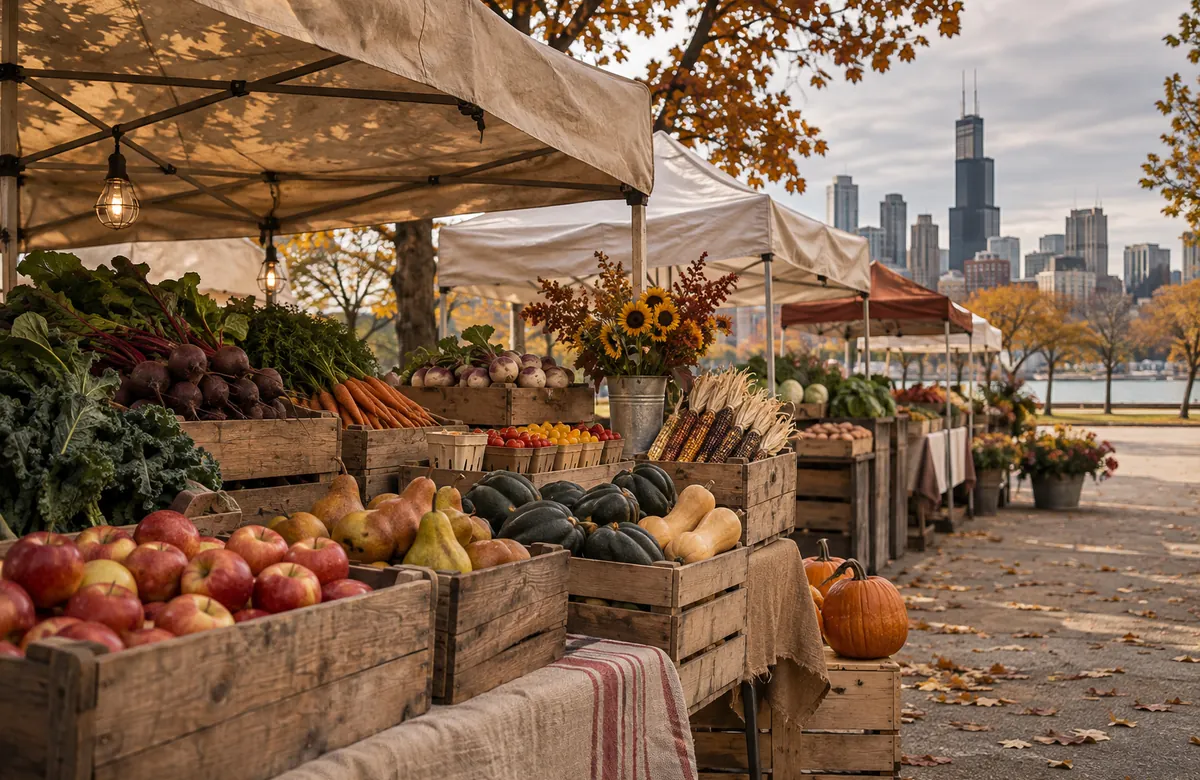
At an outdoor market, the changing selection of vegetables reveals a portion of the regional calendar. A visitor examining a stall in early summer may find a completely different arrangement on the same table a few weeks later. The effect contrasts with the familiar interior of a supermarket, where maintaining a recognizable range of items through the year is an important part of the business. The market's supplies make the changing conditions outside the city unusually visible to people living in it.
Chicago has hosted markets in many different forms. In 1912, the city formally designated a market on Maxwell Street, where vendors had already developed a substantial street trade. Its mixture of inexpensive merchandise, food and musical activity acquired a particular place in Chicago's cultural memory. Several generations later, food writer Abby Mandel founded Green City Market in 1999. Beginning with nine farmers near the Chicago Theatre, that operation moved to Lincoln Park and later developed additional ways of bringing regional growers and urban customers together.
These markets arose for different reasons. Maxwell Street involved traders offering many types of goods, and its history included considerable economic improvisation. Green City Market emphasized the relationship between local food producers and the people using their products. Examining them together helps explain why a public market can be an important institution even in a city with an extensive network of ordinary retail establishments.
The first market of the season
Neighborhood customers who visit a farmers market regularly become familiar with both places and people. A particular producer occupies a position that is relatively easy to locate during a return visit. The arrangement on the table can change from week to week, and a conversation with the person selling an item may reveal why. Weather conditions that seem remote to somebody working in a city office become meaningful when they influence what can be purchased for a meal.
A public market creates a setting in which the variation in supply can be regarded as useful information rather than simply a problem for the customer. A grower can describe something unfamiliar and offer a practical suggestion about how it might be prepared. A person who came looking for one kind of vegetable may leave with another whose qualities they had never considered. The encounter provides an immediate opportunity to connect the characteristics of the product with how it was grown.

The exchange is particularly valuable to professional and amateur cooks interested in the regional growing season. A cook who understands the normal periods of availability has more information on which to base decisions about a menu. A producer who regularly receives questions from such customers may discover interest in goods that were previously difficult to sell. The conversation has consequences on both sides of the table.
Seasonal markets nevertheless present practical difficulties for the people operating them. Producing a reliable quantity of perishable food, moving it to the city and selling it within the time provided requires considerable planning. An unusually slow market day may leave the seller with products that cannot simply be put aside until the next weekend. An exceptionally busy day can be equally difficult to manage if the table is cleared long before the advertised closing time.
Why an outdoor market needs infrastructure
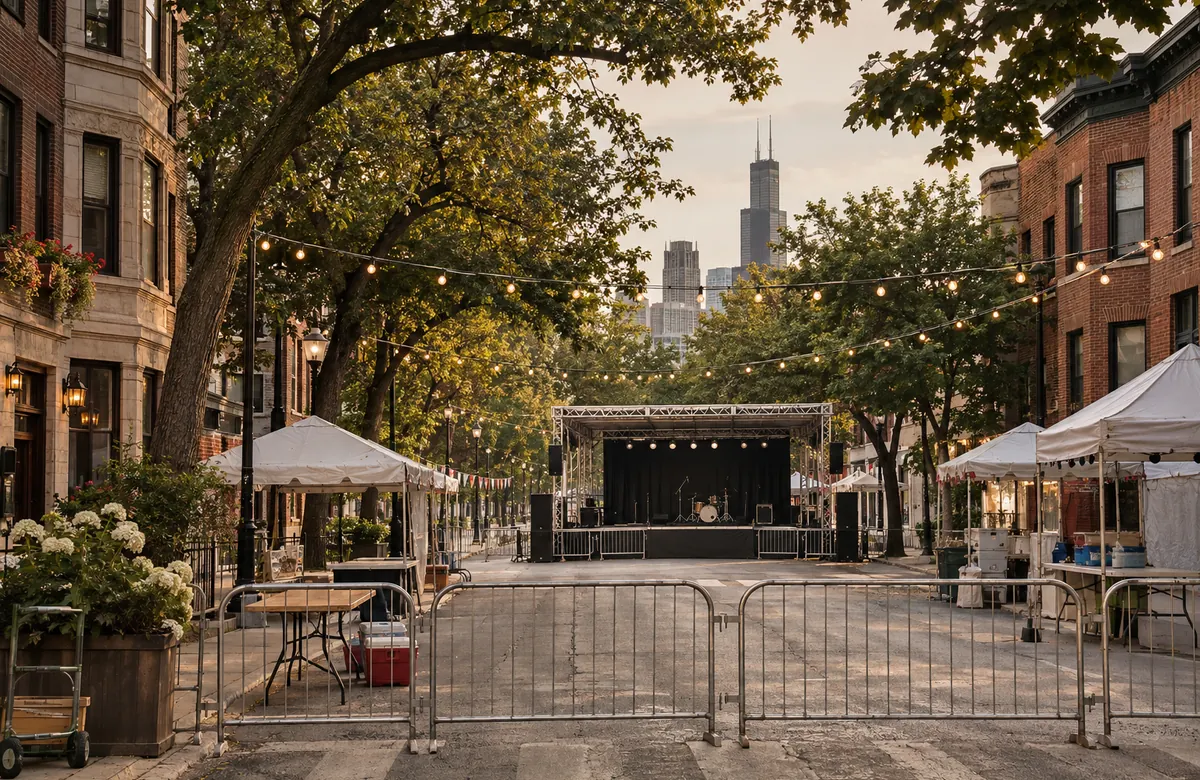
The casual appearance of a market conceals its dependence on elaborate coordination. Tents have to fit within the available space and remain safely positioned in windy conditions. Sellers need ways to unload merchandise without obstructing the routes through which customers move. Food may require particular storage conditions. The same portion of a park or street may have to return to an entirely different use shortly after the market closes.
Site selection therefore affects both the viability of the market and the people able to attend it. A location with ample open space may be inconvenient for customers without cars. A site immediately beside a well-used street can attract people who had not planned to visit, but there must be room for them to browse without blocking ordinary pedestrian travel. Accessible routes matter for sellers who use wheeled carts and customers who cannot comfortably navigate a crowded or irregular surface.
Green City Market's experience illustrates how an established institution can work with more than one sort of property. Its founder launched the market in a small downtown setting before it found a larger site near the south end of Lincoln Park. It added a year-round indoor component in 2008. A West Loop market began in 2014 and moved to Mary Bartelme Park in 2018. These changes put a familiar form of exchange into several different urban environments.
The winter component addresses a problem particularly important in Chicago. Maintaining a connection between growers and customers through the colder months can support businesses whose operating expenses continue even when outdoor markets are difficult to organize. The nature of available goods changes, and the facilities required for selling them change as well. An institution that can adapt to both seasons provides a more continuous relationship than one that simply disappears from the city's calendar for several months.
Maxwell Street and the value of modest enterprise
The old Maxwell Street Market offers a much different historical perspective. Its vendors came from varied backgrounds and sold affordable goods to residents across the city. Music became closely associated with the trade, and the market developed into a well-known destination in its own right. Its vitality grew partly from the ability of relatively small enterprises to reach customers without operating within a conventional large retail establishment.
The market's original location was closed in 1994 amid intense controversy, and operations moved east to Canal Street. Later arrangements changed again. The relocation revealed a difficulty in preserving any activity dependent on a particular combination of streets, nearby businesses and regular visitors. Maintaining the name and the basic commercial function may be possible, but customers and vendors have to learn a new geography. A street that became familiar through years of repeated visits cannot simply be reproduced somewhere else at the same scale.
The history also illustrates the value of trade whose individual transactions may seem insignificant to outside observers. A small purchase might not attract much attention from an analyst studying the total economy of Chicago. For the customer, however, discovering a needed household item at an affordable price may be quite important. The aggregate effect of thousands of these ordinary encounters helps explain why the disappearance or relocation of a market can provoke such strong reactions.
There is much to learn by looking beyond the most picturesque accounts of the old Maxwell Street. A recording of a musician or a photograph showing a crowded street preserves an important part of the atmosphere, but the activity also provided a means of livelihood and a supply of goods. The relationships between those economic and cultural features contributed to the market's distinctive character.
The pleasure of a repeated visit
Markets can be approached as special attractions, but their most revealing feature is the possibility of repeated ordinary use. A person returning to a farmers market can observe changes in the regional supply of food. A regular customer at a merchandise market develops a sense of which items are available and which sellers know the most about them. Neither kind of experience can be completely captured in a single afternoon.
Public gathering is often described as a separate activity from the purchase of something needed at home. The market combines these two purposes. A customer chooses an ingredient for supper or obtains a useful object while spending time in a setting shared with other people. Conversation emerges without the need for an event organized specifically around dialogue. The small transaction creates a reason to visit, and the visit can develop in unexpected ways.
Chicago's market histories suggest useful questions about contemporary urban commerce. Where can a person with a small business reach customers? How easily can residents compare goods and learn about their origins? What kinds of public facilities make those exchanges possible without requiring an expensive permanent building? The answers vary with the type of market and the available neighborhood space. One of their enduring benefits is easy to experience directly: an ordinary shopping trip becomes an opportunity to learn a little more about the people and places that supply the city.