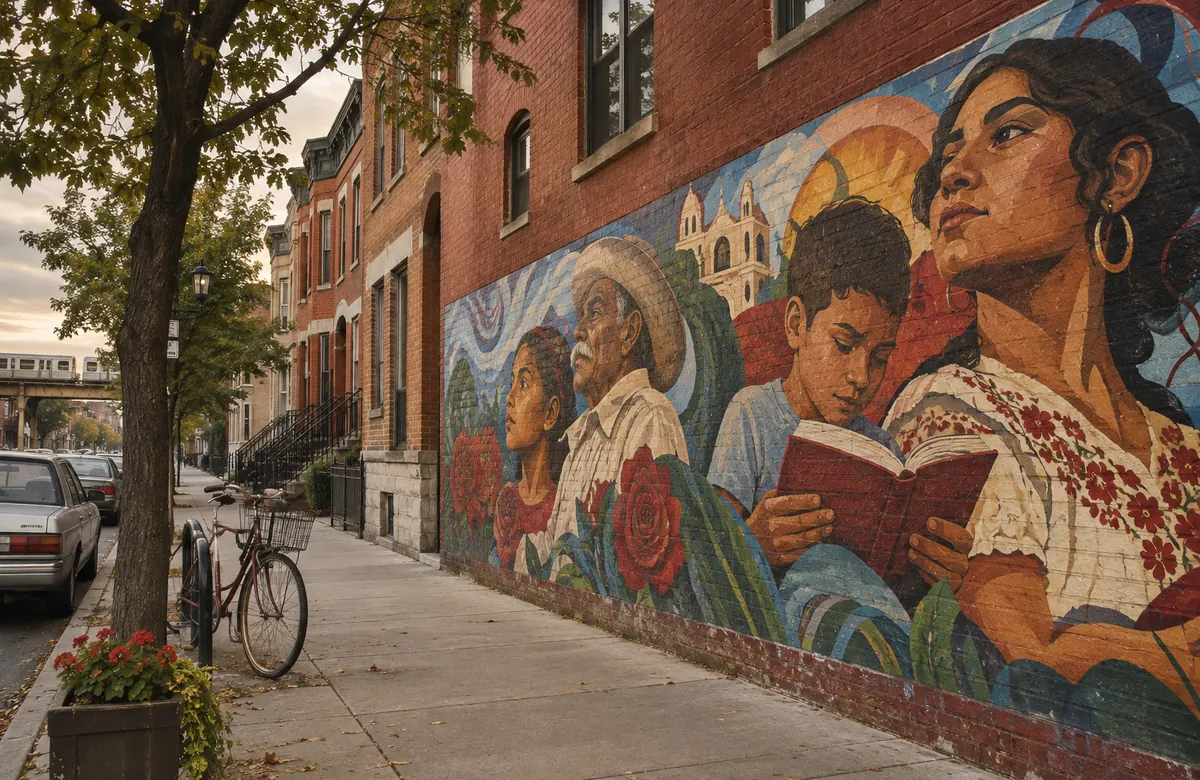
Walking through Pilsen can require a change in the ordinary discipline of looking at buildings. A painted wall may contain a figure with a detailed expression, a row of words or a substantial scene stretching from the sidewalk to the roof. A visitor interested only in the businesses occupying a block can miss a narrative unfolding above the shop windows. Standing back often helps, but a closer look can reveal details a photograph of the whole composition would not record.
Public art in this part of Chicago is unusually intertwined with ordinary routines. The murals occupy places people pass on their way to the train, to school or to a family visit. They are not assembled into a single exhibition with a set of opening hours. Some are painted on walls facing particularly busy streets; others demand an accidental turn into an unfamiliar block. Their audiences are composed as much of people who live with the works as of those who travel specifically to see them.
The Mexican-American cultural institutions and artistic traditions associated with Pilsen help make the neighborhood's painted surfaces meaningful. The National Museum of Mexican Art, established by educators and first opened in 1987 as the Mexican Fine Arts Center Museum, has long supported the presentation and study of Mexican art. The murals found in the streets are part of a wider artistic life in which education, community memory and the creation of public images intersect.
The station as an exhibition space
One revealing destination is the Pink Line's 18th Street station. Painted and decorative work associated with the station includes murals by Francisco Mendoza and participants in the Gallery 37 program. The images make reference to Mexican history and the heritage of the people who built and sustained the surrounding neighborhood. At Damen, another Pink Line station in the area, Juan Angel Chavez's glass mosaic uses a different medium to explore local ideas of identity.
An artwork displayed in a transit station encounters a particular audience. Passengers spend a limited and unpredictable amount of time with it. Someone may see the same section every morning for years without looking at the entire work at once. Another person may move through the station slowly for the first time and notice how the images relate to the architecture surrounding them. A painter or installer working in such a space has to consider sightlines, structural divisions and the wear that comes from constant public use.
That persistence is one of the advantages of art in a station. A museum visitor may remember a painting from a single afternoon; a passenger can establish a long relationship with an artwork encountered in fragments. Small changes in routine, such as waiting for an extra few minutes, create new opportunities to study it. A familiar image can come to mark the difference between arriving home and traveling through an unfamiliar part of the city.
A wall is not an empty page
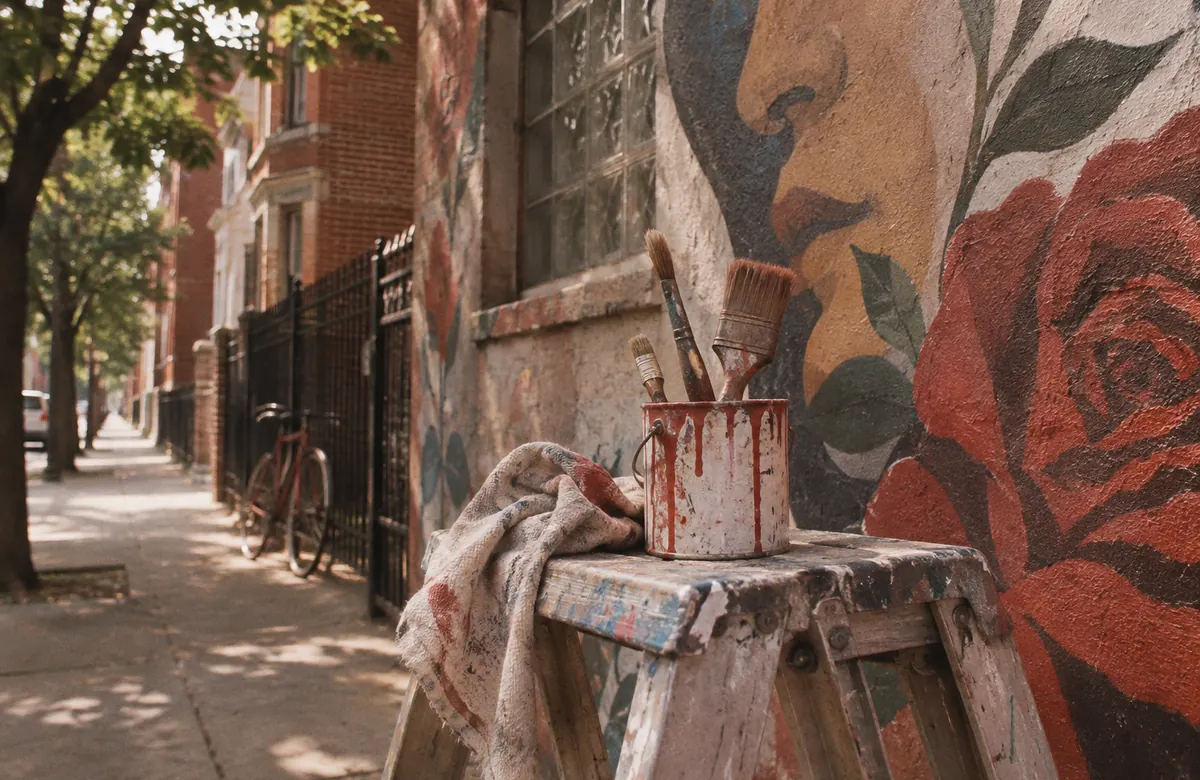
Murals in Pilsen reflect the problem painters everywhere face when working with existing buildings. Masonry has seams and varying textures, and a wall may contain windows, doors or irregular surfaces. Its orientation determines which parts receive strong daylight. Nearby buildings restrict the distance from which the painting can be viewed. Painted imagery designed for a particular wall can use these conditions rather than treating them as defects.
The best way to examine a mural usually includes both close and distant views. From the opposite sidewalk, the larger arrangement becomes clear. On the same side of the street, the construction of an individual figure or the meeting of adjacent blocks of color becomes apparent. Layers of paint and repairs sometimes provide evidence that a wall has been used for several artistic purposes over time.
Its history does not necessarily end when a painter signs the work. Weather, direct sunlight and alterations to the building affect the surface. Responsibility for repairs may be unclear, particularly if the ownership of the property changes. A mural may have considerable meaning to neighbors even when they have no legal control over the building that supports it.
This tension makes documentation especially valuable. Images recorded over the years can establish what a wall looked like at different times and preserve the names of artists whose work might otherwise be forgotten. A useful record also identifies the building, the dates when the work was known to exist and the source of any claims about its creators. Merely sharing an anonymous image labeled with the neighborhood's name contributes much less to the history of the artwork.
The story beyond an attractive background
There is a tendency in accounts of colorful neighborhoods to make the murals serve primarily as decoration for visitors. Photographs may position painted figures behind a posed subject. Guides sometimes collect the photographs into a quick list of places to stop. There is nothing inherently wrong with enjoying the images or taking pictures of them. The problem arises when an image is treated as though it has no narrative or relationship to the location.
In Pilsen, many motifs are tied to Mexican history, migration and the concerns of ordinary families. Understanding that background can substantially change a person's view of a composition. A portrait may be meaningful because of the historical individual it depicts rather than because its colors suit the surrounding buildings. A scene involving labor may describe a condition familiar to the residents who helped create or commission the work. A political image can outlast the particular event to which it was responding and acquire a more complicated meaning over time.
The museum provides a valuable complement to outdoor viewing for this reason. Its collections offer a chance to consider visual traditions in a setting where historical information accompanies the artwork. Going from a public mural to a gallery and then back into the street encourages visitors to see both kinds of art in relation to one another. Neither is required to look exactly like the other.
Whose neighborhood is represented?
Pilsen's artistic reputation has created a difficult situation familiar in Chicago and other large cities. Cultural distinctions that made a neighborhood important to its residents can also attract newcomers and commercial investment. Painted walls become recognizable elements in descriptions of the area even as the people and organizations involved in their creation face changes in rents and the availability of workspaces. A mural can remain in place while the community that commissioned it changes substantially.
Preservation therefore involves more than protecting popular images. It also involves maintaining conditions in which people can keep creating new ones. Affordable studios, teaching programs, art supplies and arrangements with property owners can all influence who gets to contribute to the next generation of walls. A community painting project may depend on hundreds of modest practical decisions that never appear in the finished composition.
An important distinction can be made between preserving a neighborhood as a scene and preserving it as somewhere where culture is made. The first approach may focus on how recognizable buildings and streets look in a picture. The second is concerned with whether a painter can rent a workspace, whether an arts teacher has access to materials and whether a community group can organize an event on the block. The visual results matter, but the ability to keep producing them matters at least as much.
An artwork encountered again
Every visitor to Pilsen will assemble a slightly different mental collection of its murals. The precise route and the amount of time available matter. An image may be obscured by sunlight bouncing off a nearby window, or a passing truck may hide the bottom part of the painting. On a subsequent walk the same wall may reveal an inscription that went unnoticed earlier. It might have been restored or entirely replaced.
The possibility of returning is one of public art's pleasures. Nobody has to memorize an entire wall within the scheduled length of a visit. People are free to spend time with the paintings wherever their ordinary activities lead. The works begin to make the most sense when one moves between them and the rest of the neighborhood: a station, a grocery, a museum, a corner where several people are speaking. The stories along the walls belong to those places.