An editor evaluating a new publishing system is usually shown the most polished part first. A blank page turns into a convincing article as somebody chooses a headline, a photograph and a typeface. The person demonstrating it puts the new article on the site in seconds. The editor thinks about how much easier tomorrow's work could be. But tomorrow's assignment may involve revising an article that appeared last year, replacing a faulty audio file or finding a photograph that a former contributor uploaded under a different account.
A content management system is the part of a publication where editorial material becomes a public record. The editor should evaluate it on the whole life of that record. Speed of first publication matters. So does the publication's ability to locate, revise and preserve its work after the excitement of the initial release has worn off.
Describe the work behind one story
Choose a recent article and reconstruct how it reached the web. A contributor may have submitted the text in a document, the editor checked claims and requested changes, a photographer supplied images, and an editor arranged the headline, description, credits and related reading. Someone decided when the story could appear and another person checked the finished page.
Give that story to the prospective publishing system as a test. Can the writer submit a draft without being able to make it public immediately? Can the editor review revisions? Does the text editor preserve legitimate headings and paragraphs without introducing unexpected formatting? Find where the caption goes and determine whether the credit remains associated with the picture when it is reused.
The process needs to accommodate variations. A short event notice should not have to pass through the same lengthy procedure as a sensitive investigation. A complex story, however, should not become public simply because a contributor clicked a button while saving revisions. Examine the controls for different categories of work using accounts with the appropriate roles, rather than relying on a tour of an administrator's account.
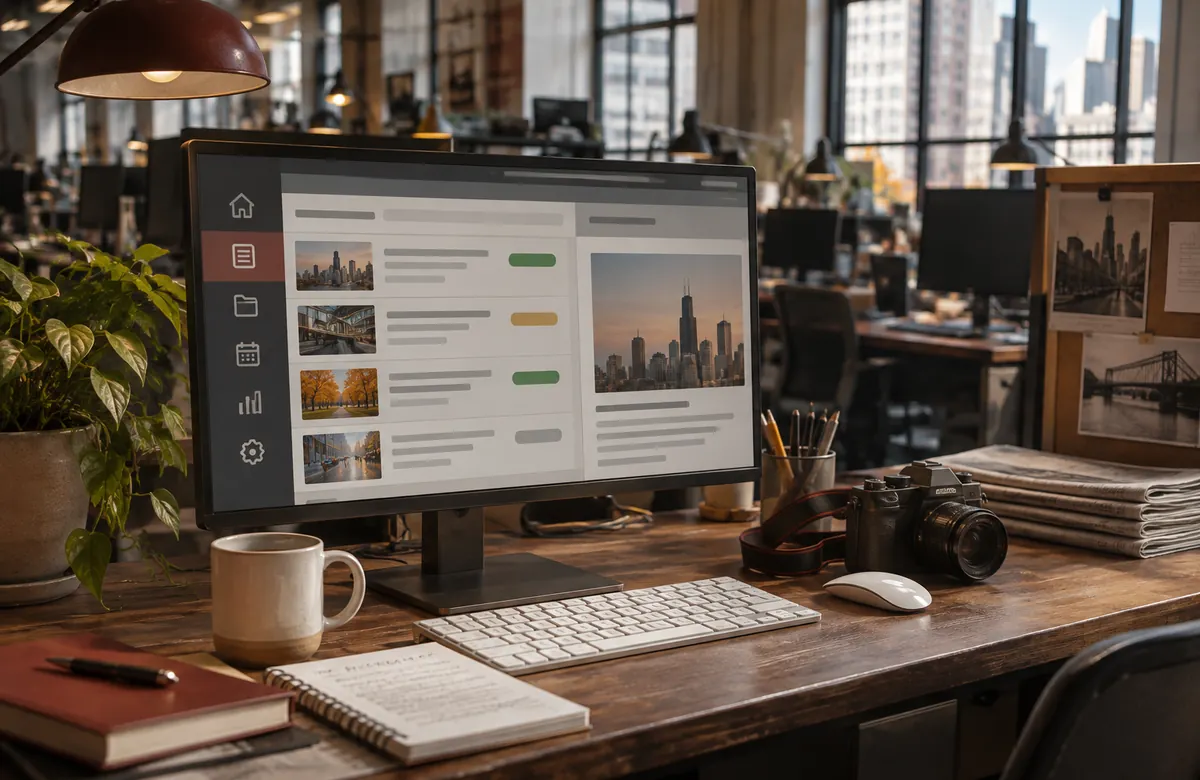
Look at the editing experience on the devices staff regularly use. A reporter may need to submit a correction from a small laptop outside the office. The production editor might handle much of the page layout at a desktop monitor. They do not necessarily need identical interfaces, but they should have a dependable way to perform their assigned work.
Store editorial information distinctly
The article body, title, author information and publication date should be identifiable as data, not simply as pieces of text whose meanings depend on an individual page design. If the publication later changes its visual identity, it should still know which line belongs to the headline and which date represents original publication.
Examine the system's treatment of updates. Changing a typo should not automatically cause an archival article to be presented as new reporting. An editor may wish to display the date of a substantive revision without obscuring the date the article originally appeared. Find out whether the system retains revisions and whether someone can recover a prior version without disrupting the current public page.
The system should also handle photographs as more than interchangeable pieces of decoration. A caption, credit and alternative text serve distinct purposes. Test whether each can be edited and retained. If the layout uses an image in a second context, decide which information comes from the asset record and which information should be reviewed for the particular use.
A system that preserves structured text often makes more than one distribution product feasible. An editor could prepare article listings, an email digest or a feed from the same basic record. The publication does not need to launch all of those products at once. The advantage is that it can do so later without manually rebuilding a substantial part of the archive.
Inspect the public pages, not just the editing interface
Take the test article to a narrow phone screen. Read the piece itself. Are the lines comfortable to follow? Does the layout accommodate long names in headings? Can captions be distinguished from nearby paragraphs? Open an article from a category page and return to that page. It should be clear where the reader is within the publication.
Look at the article with images still loading or with a limited connection. A reader interested in a city meeting may arrive while traveling and need the essential details immediately. A visually elaborate front page must not obscure the work that the publication's reporters have done. Most of the information should remain available as ordinary, meaningful text.
Check headings, link text and the ability to move around the site using a keyboard. A system may allow an accessible page to be assembled, yet encourage contributors to use visual formatting in place of semantic structure. An editor who understands which controls produce a real heading can avoid many such mistakes. A publishing system that makes the right choice obvious reduces the need for constant intervention.
Inspect how pages describe themselves for sharing and search. A useful system permits the editor to supply meaningful descriptions and titles while preserving stable, understandable addresses. These opportunities should improve the description of the story. They are not a reason to write a headline that promises reporting the article does not contain.
Plan for old addresses and corrections
The domain of an independent magazine accrues a history. Readers save article addresses in bookmarks, neighborhood organizations refer to past coverage, and people cite reviews of exhibitions that closed years ago. If the publishing system is replaced, the new edition should not destroy those paths unnecessarily.
Inventory the existing public addresses before a move. Determine how the replacement will represent them. When an article must move to a different address, create the appropriate permanent redirect where a genuine equivalent exists. An old news article generally should not be redirected indiscriminately to an unrelated new story or the magazine's cover page. The person following the old address came looking for a particular item.
Corrections deserve an equally practical test. Suppose a contributor discovers a significant factual error in a published feature. Can an authorized editor correct the text, add a visible note explaining the substantive change and preserve the history of the work? Is there a simple procedure for updating connected article listings when the headline also needs revision? Try it before committing to the system.
Know what the publication owns
Determine how to export the articles and their supporting data. A system may produce visually attractive pages without providing a convenient way to retrieve a whole archive. Ask how exported images connect to exported text and whether permissions information is included. Try opening the results without the original service. A folder of files is not much help when every file depends on an undocumented internal relationship.
Control the domain and the publishing accounts through the appropriate organization. Keep recovery information and billing arrangements up to date. An independent magazine can change its design while preserving its address, and it can change its host without surrendering control of its editorial records. Those freedoms are worth preserving when entering a software arrangement.
Try recovery on a small scale before relying on a backup procedure. Export some edited and published pieces, then use the exported material to reconstruct one in a test environment. Include at least one article with several media elements and a correction note. The test may uncover information that a simple sample omitted.
An editor choosing between two adequate systems may find that the most useful distinction is modest. One makes the everyday sequence of submission, revision, production, publication and occasional correction noticeably easier for the people doing the work. The other offers a striking collection of page designs but leaves some ordinary tasks awkward. A magazine will see thousands of ordinary tasks for every substantial redesign. Choose a system that accounts for that arithmetic, as well as one that makes the first article look good.